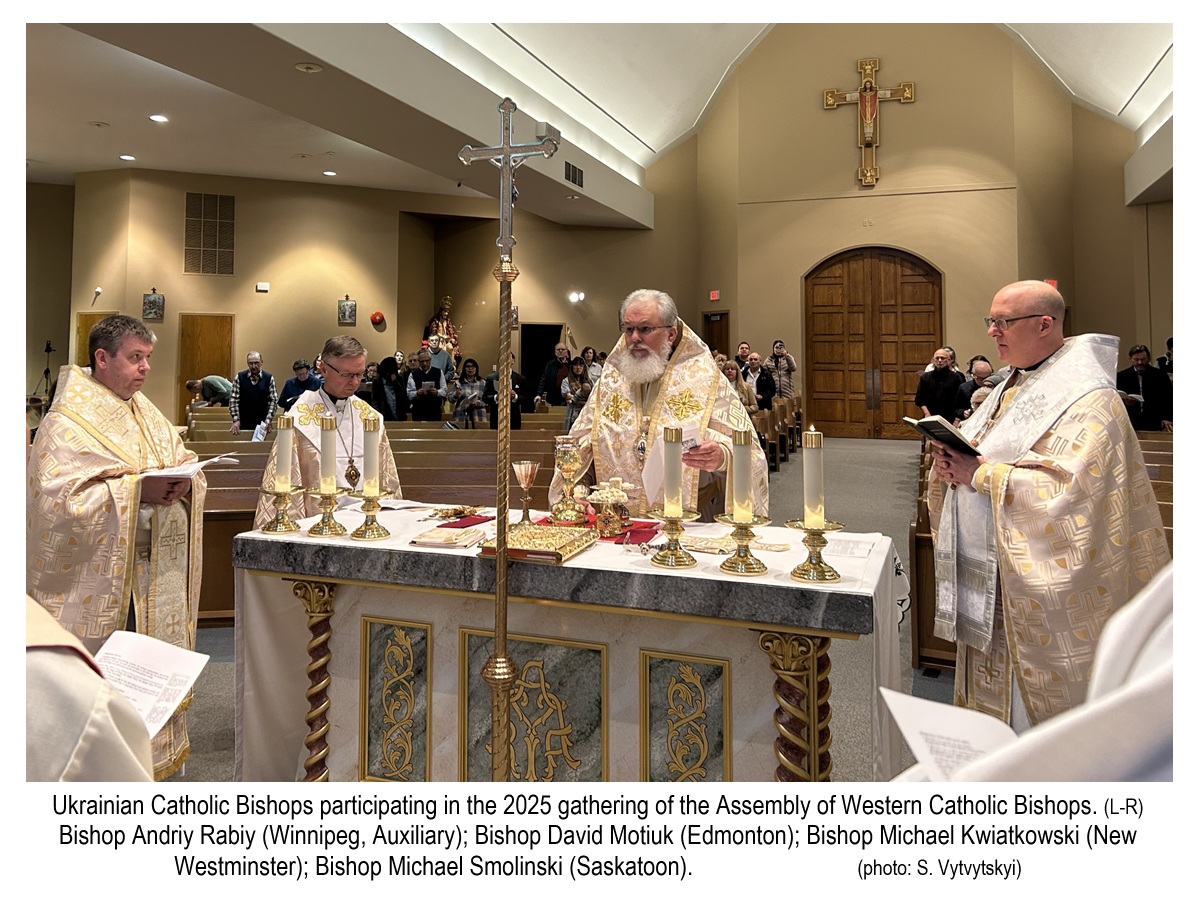
Canada has a national body of Catholic Bishops known as the CCCB - Canadian Conference of Catholic Bishops. However, the country was also divided into four regions so that the Church could better deal with local pastoral issues and needs in a certain area of our vast country. The AWCB - the Assembly of Western Catholic Bishops was established in 1974 to serve as a gathering for all Catholic bishops – eastern and western – from across Canada’s western provinces and the Yukon and Northwest Territories. By actual territory designation, it includes 22 eparchies and dioceses. Although there are other Eastern Catholic Bishops who have parishes in Western Canada (e.g. Chaldean, Melkite, Syro-Malabar, etc.), for the most part, it has been the Ukrainian Catholic hierarchy that participates regularly in the gatherings and activity of the AWCB. Ukrainian Catholic Bishop David Motiuk of Edmonton, has even served as the President of the Assembly. The present Ukrainian Catholic Bishops serving as active members of the AWCB are Metropolitan Lawrence Huculak (Winnipeg), Bishop David Motiuk (Edmonton), Bishop Michael Kwiatkowski (New Westminster), Bishop Michael Smolinski (Saskatoon) and Bishop Andriy Rabiy (Winnipeg).
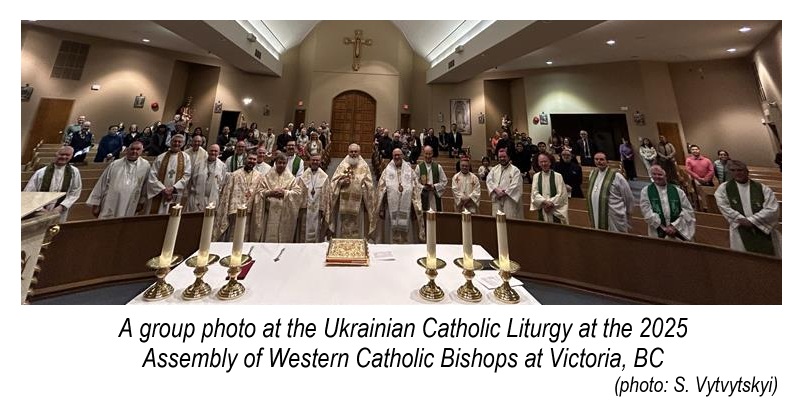
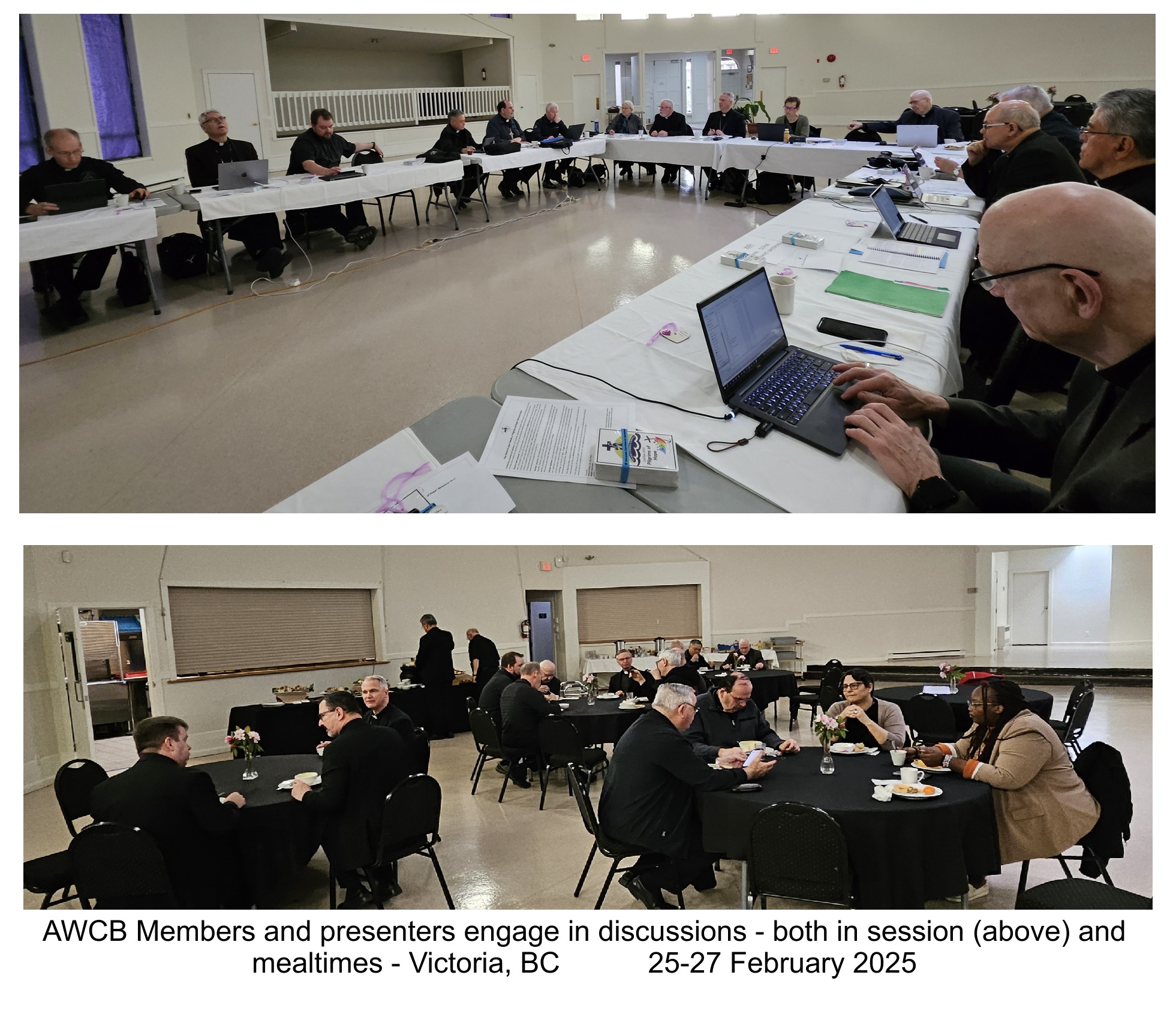
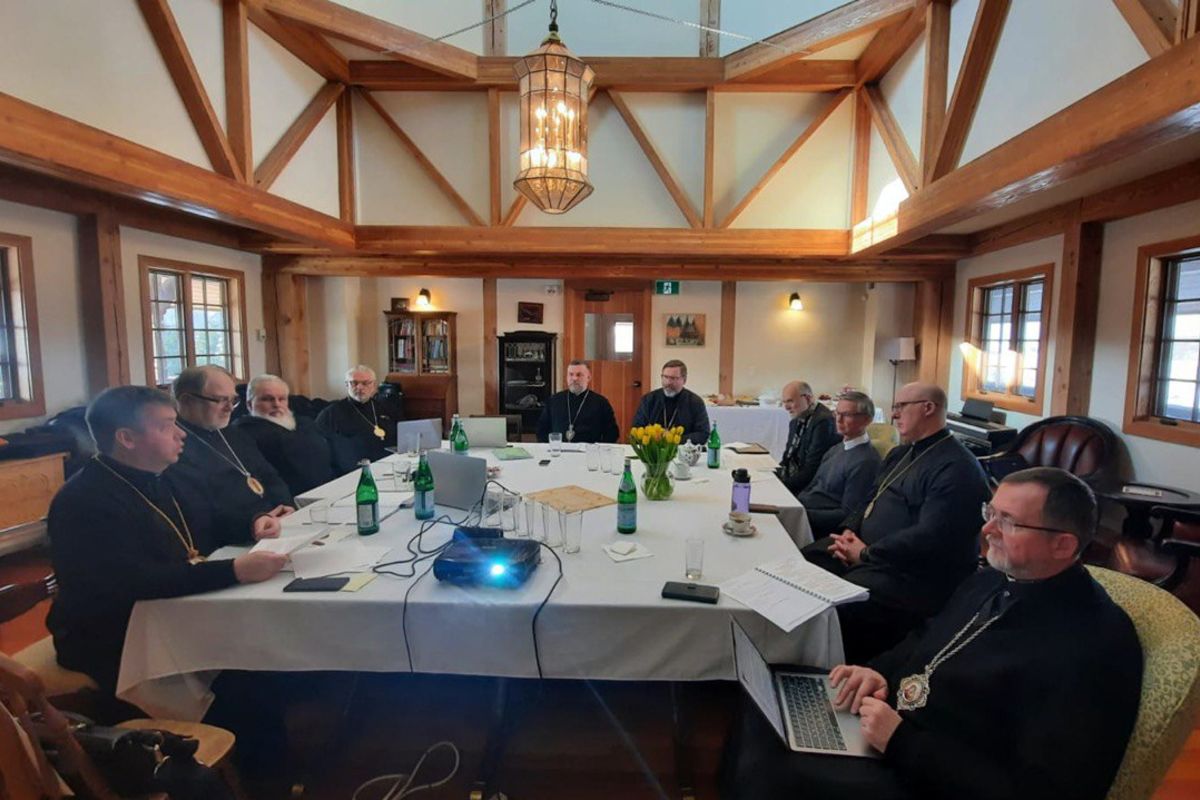
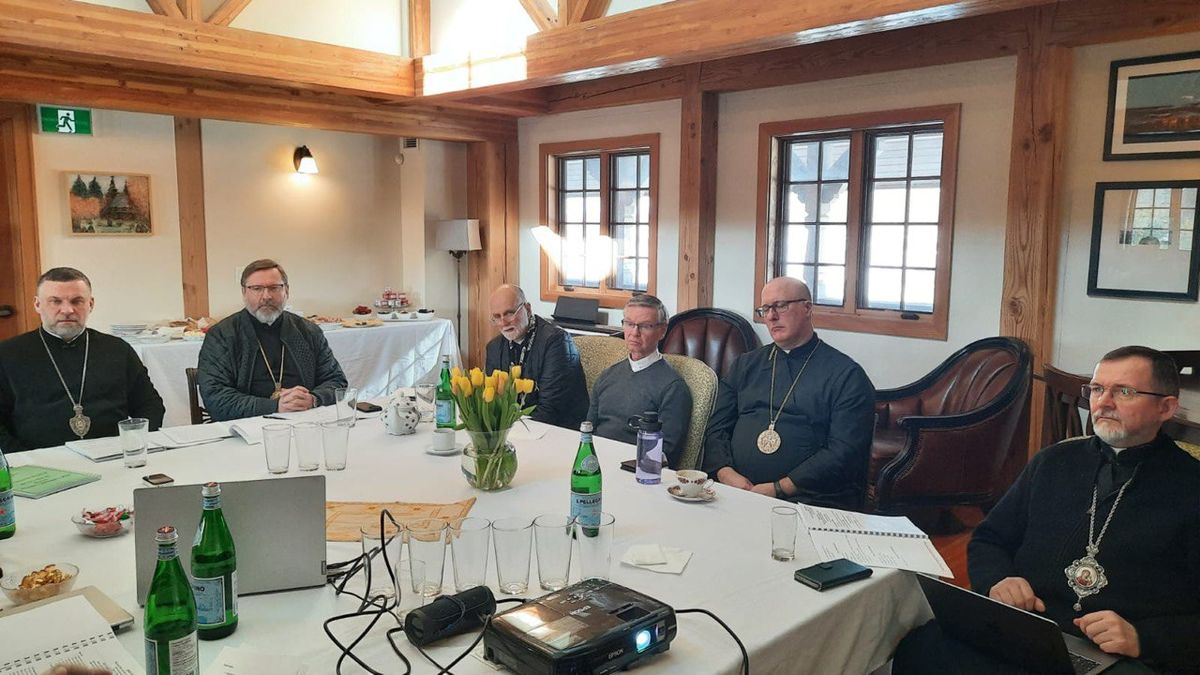
The AWCB’s 2025 annual gathering took place in the Saanich municipality of the Greater Victoria area on Vancouver Island from 25-27 February. A unique aspect of this year’s gathering was that, although the bishops spent the nights nearby, all the prayer services and the sessions and most of the meals occurred at Our Lady of Fatima Parish. In fact, the parishioners were invited to attend the daily Eucharistic Liturgies, which added a great spirit to the services. The Ukrainian Catholic bishops were asked to lead some of the services. Bishop Andriy Rabiy from Winnipeg lead the First Hour on the second day, Bishop Michael Kwiatkowski lead the Divine Liturgy on the third day. Of course, the other bishops concelebrated.
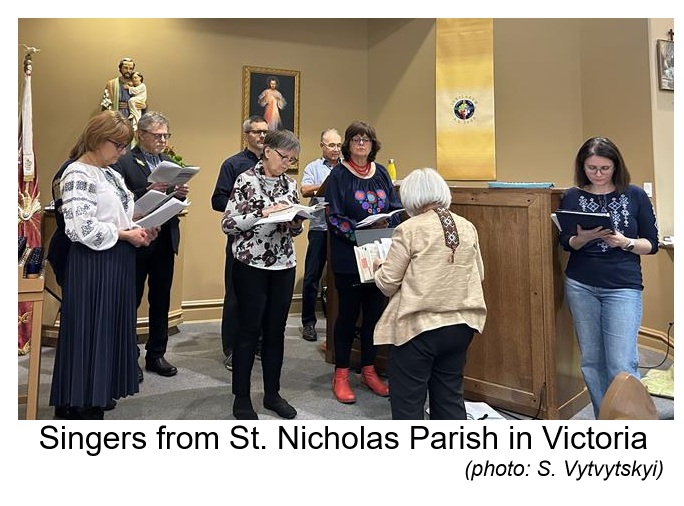
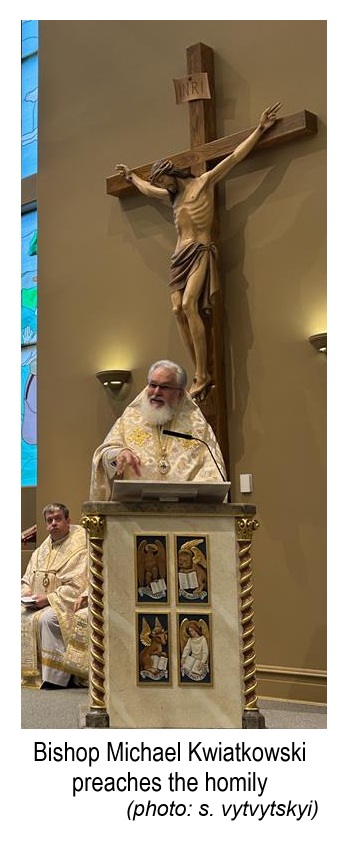
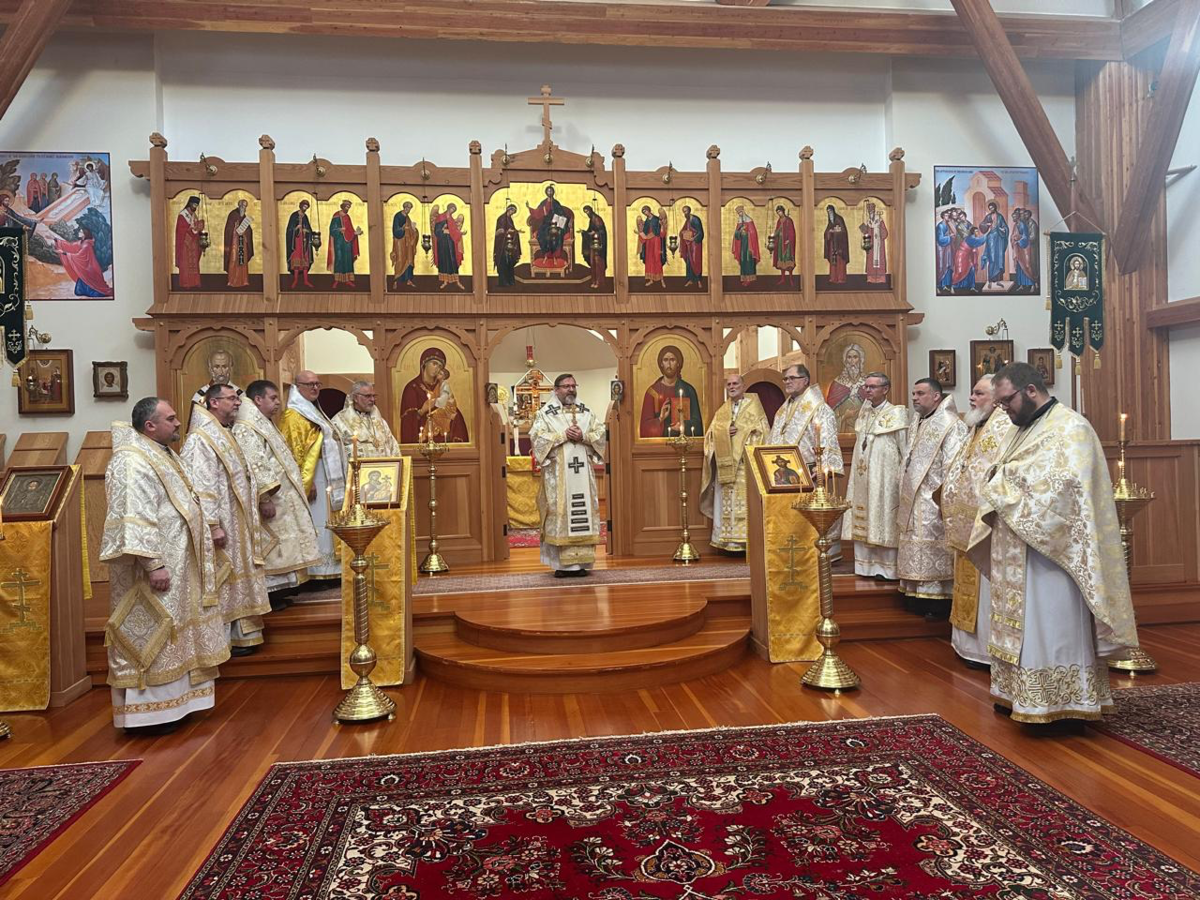
The Ukrainian Catholic Byzantine Divine Liturgy was truly a highlight of the gathering. Besides the four Ukrainian Bishops, two of our Island priests helped arrange everything and even brought some of their faithful to join and help with the responses. Father Yuriy Vyshnevskyy (St. Nicholas, Victoria) and Father Stepan Vytvytskyi (St. Michael, Nanaimo) and their parishioners really brought the Liturgy alive for a church full of people - many who did not have that much experience with the Byzantine Liturgy. The choir from Victoria really raised the souls of all present. During the homily, Bishop Michael touched upon the Jubilee Year, the work of the bishops during the assembly and a request for prayer for the bishops, for an end to the war in Ukraine and for our own personal conversion and renewal.
The AWCB three-day conference dealt with a variety of topics that included everything from catechism, clergy formation, insurance, Evangelization, MAiD, and reconciliation and collaboration with our indigenous peoples to Catholic education, vocations, religious movements, ecumenical outreach and social communications and media (as well as several other topics).
Please pray for your Bishops. As Bishop Michael said in his homily, “if you could be present for the sessions of the assembly of bishops, I know you would be inspired by the way the bishops truly love the Lord, love the Church and are focused on the spiritual and pastoral wellbeing of the God’s People and seek the best ways to serve their people in spite of challenges and even very complicated situations!”
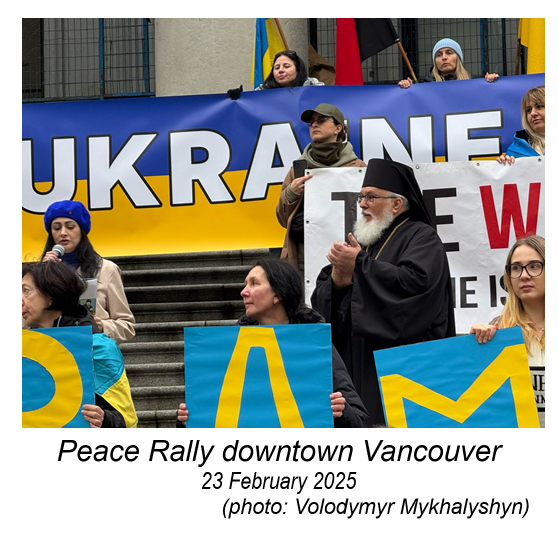
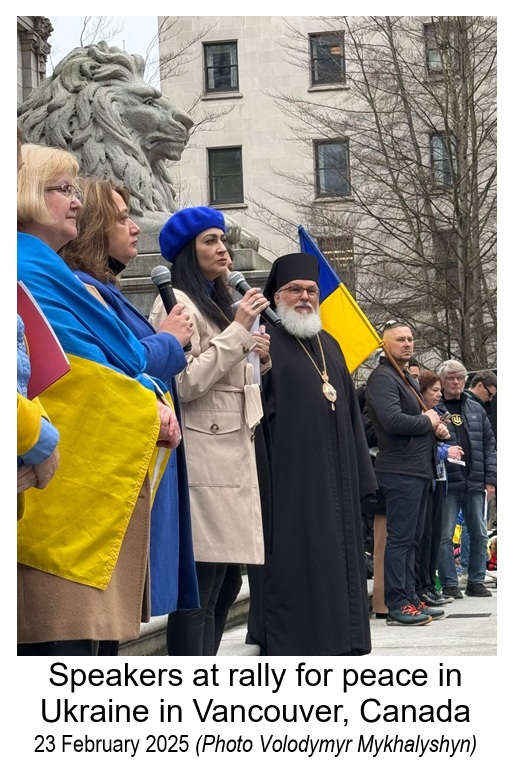
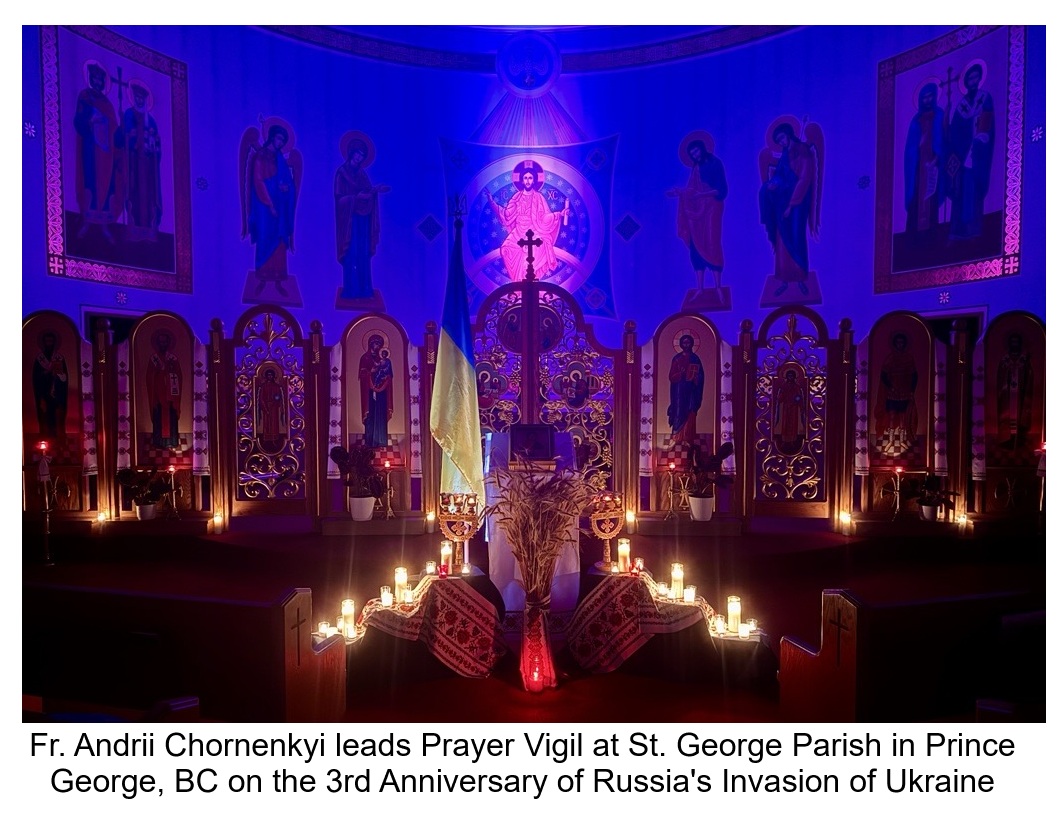
The Eparchy of New Westminster prays daily for Ukraine. We pray daily for an end to the brutal war brought across the borders by Russia some eleven years ago and intensified horrifically three years ago with the full-scale invasion. On Sunday the 23rd of February, parishes and communities throughout the Eparchy focused the prayer for peace. Aside from prayers during the Eucharistic Liturgies, many offered additional petitions, a panakhyda (requiem service) or even a program of focused prayer.
In several cities a public manifestation was held in the town square in which our parishioners and clergy prominently participated. In some cases, it was representatives of the Ukrainian Canadian Congress that spearheaded the organization of the rallies, but they invited all Ukrainian entities to join, including Ukrainian church communities. In Vancouver, Bishop Michael opened the event at the Art Gallery with a message and prayer. Other clergy and faithful were in attendance.
Later in the day, some parishes hosted vigils to which the wider community was invited. At Holy Eucharist Cathedral Bishop Michael led a well-attended vigil that began at 17:40 as that would correspond directly with the time in Ukraine (3:40 AM) when the first reports were being made about missile strikes and fighting between invading Russian troops and Ukrainian Armed Forces.
The evening began with Bishop Michael accenting that the gathering was not a rally, or a challenge directed toward the aggressor. It was a prayer vigil in which we gather in the presence of our Lord and humbly ask His mercy in ended the war and restoring peace so the people of Ukraine could continue to live their lives in peace to work out their salvation in fear and trembling (Philippians 2:12).
The evening began with a Moleben’ to the Mother of God served by the Bishop and other clergy. Responses were led by the Cathedral choir under the direction of Halyna Bybyk. Within moments of the last Amen, the warning sirens that people in Ukraine hear daily, pierced the tranquility and people were urged to move to the basement “bomb shelter”.
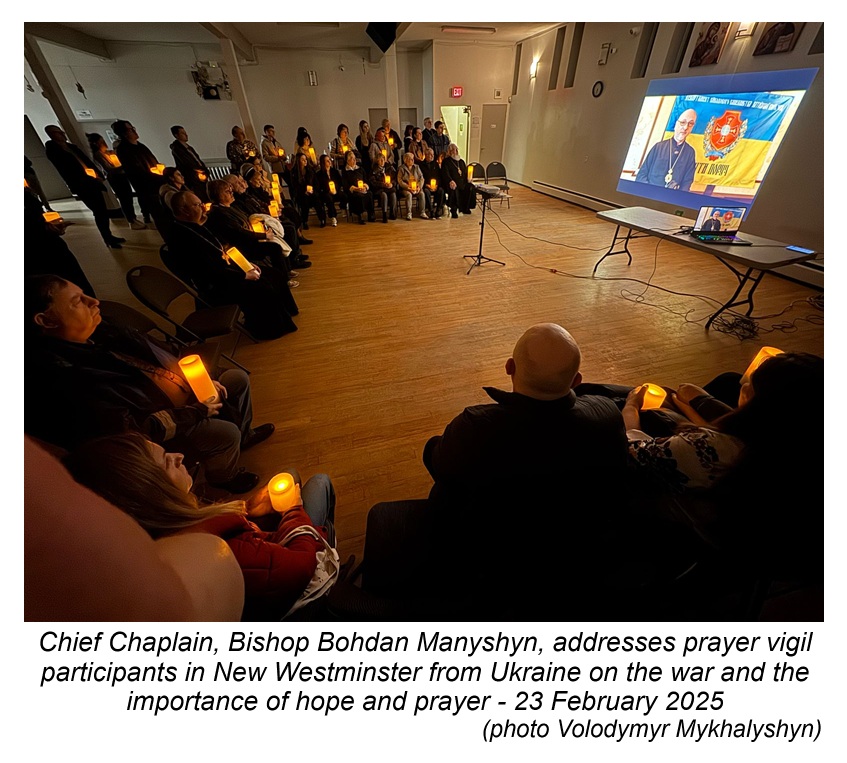
In the basement, Volodymyr Mykhalyshyn facilitated a program that included several moments of meditation. Bishop Bohdan Manyshyn, the head of the Department of Military Chaplaincy of the Ukrainian Catholic Church, spoke to the gathering, telling us about the situation of the war in Ukraine, but especially of how the Church brings hope and comfort to the soldiers on the front, and to the millions who are traumatized throughout the country. This was followed by a review of photos and images of the people in Ukraine accompanied by the violin music of Maryna Popova.
The people made their way back to the church and prayed a panakhyda for the countless victims of the war. Father Dr. Yuriy Sakvuk spoke at the conclusion. The night was not yet over. The youth offered to lead those who wanted to stay in a variety of songs - mainly from the Taizé community.
Let us continue to pray daily for an end to the war in Ukraine with a just and God-willed outcome!
22 лютого 2025 року у м. Торонто розпочалися засідання Постійного Синоду Української Греко-Католицької Церкви.
Цього разу участь у засіданнях Постійного Синоду беруть участь єпископи-члени: владика Борис Ґудзяк, архиєпископ і митрополит Філадельфійський зі США, владика Володимир Ющак, єпископ Вроцлавсько-Кошалінський з Польщі, владика Йосафат Мощич, єпископ Чернівецький з України та владика Богдан Дзюрах, апостольський екзарх для українців візантійського обряду у Німеччині та Скандинавії. Головує під час засідань Блаженніший Святослав, Отець і Глава Української Греко-Католицької Церкви, а обов’язки секретаря здійснює владика Андрій Хім’як, єпископ-помічник Київської архиєпархії.
Традиційно, розпочався робочий день Архиєрейською Божественною Літургією на парафії Святого пророка Іллі у Бремптоні.
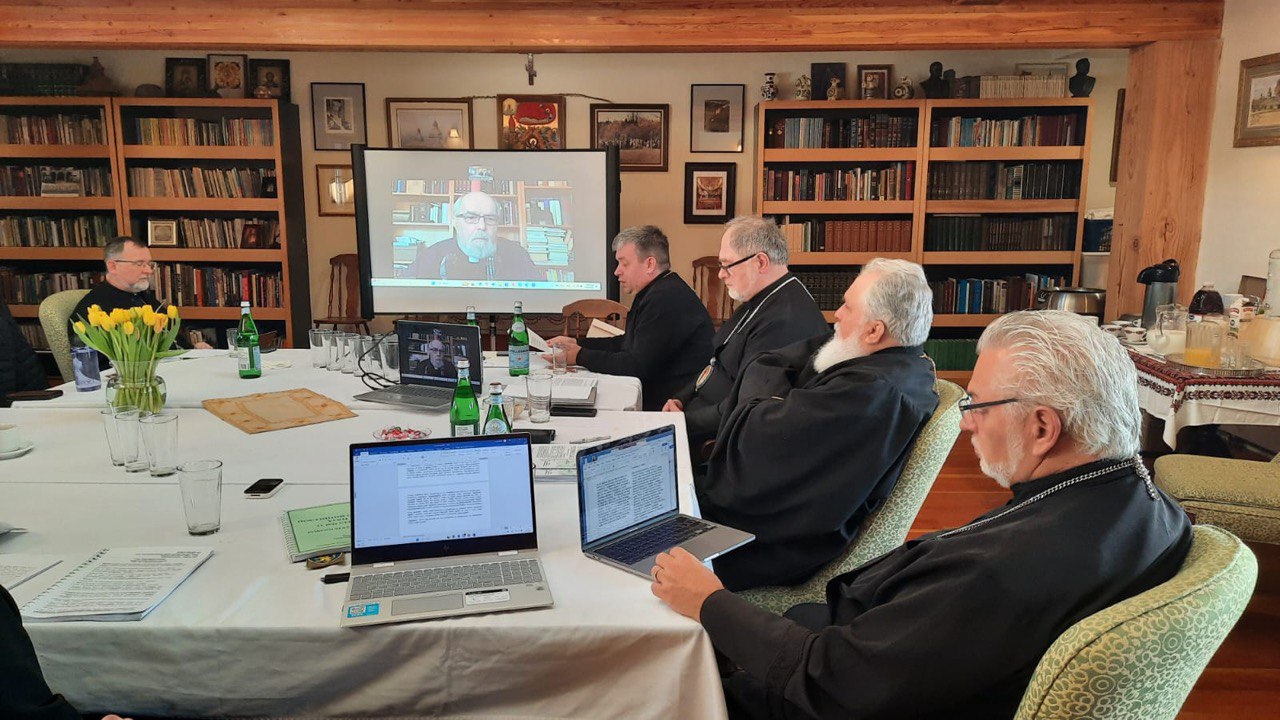
Два робочих засідання 11 (82) сесії Постійного Синоду у суботу були позначені зустріччю з українськими католицькими єпископами, що здійснюють своє служіння у Канаді. За словами владики Андрія Хім’яка, секретаря Постійного Синоду УГКЦ, така зустріч стала «нагодою творення спільноти і свідченням єдності глобальної УГКЦ».
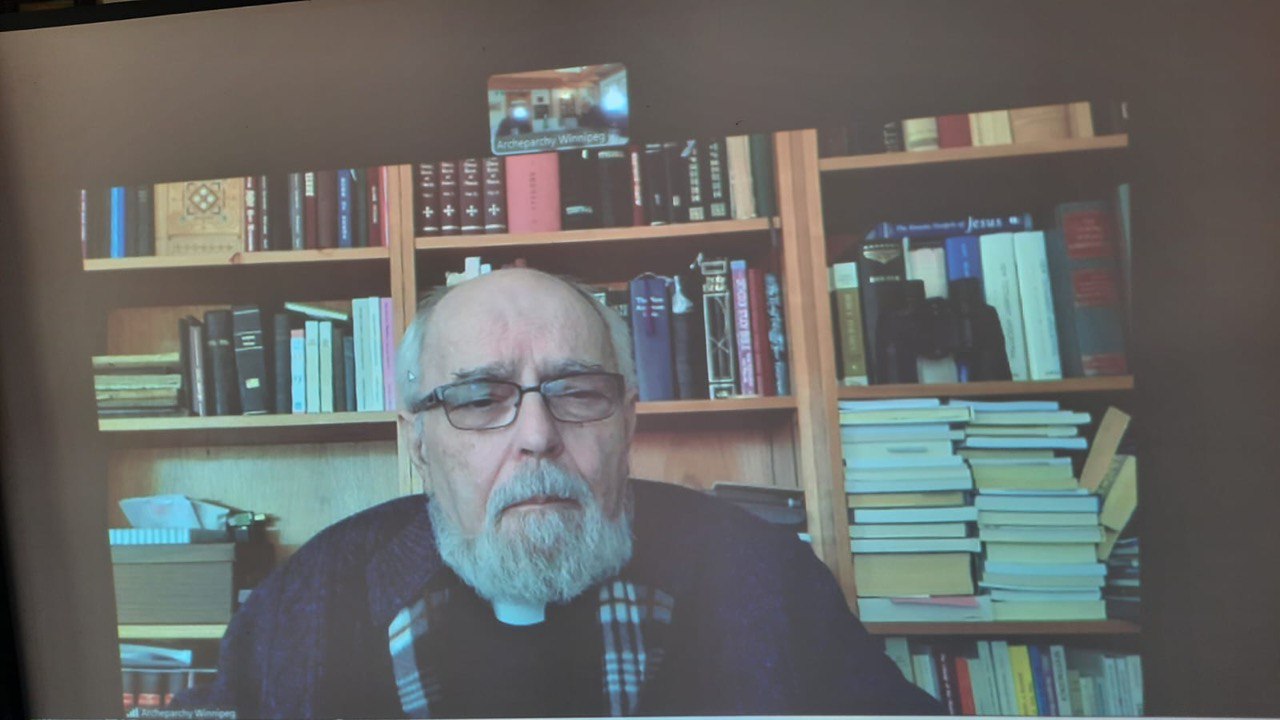
Серед прибулих на зустріч єпископів з Канади були владика Браян Байда, єпископ Єпархії Торонто та Східної Канади, владика Давид Мотюк, єпископ Едмонтонської єпархії, владика Михайло Кв’ятковський, єпископ Нью-Вестмінстерської єпархії, владика Михайло Смолінський, єпископ Саскатунської єпархії, та владика Андрій Рабій, єпископ-помічник Вінніпезької архиєпархії. Архиєпископ і митрополит Вінніпезький Лаврентій Гуцуляк долучився до зустрічі за допомогою онлайн-зв’язку.
Під час зустрічі єпископи з Канади повідомили про душпастирську ситуацію у Вінніпезькій митрополії.
За їхніми словами, відповідно до державних статистичних даних, після 24 лютого 2022 року до Канади прибуло близько 300 тис. українців. Більшість з них зосереджена в єпархії Торонто і Східної Канади. «Українська Католицька Церква в Канаді у різний спосіб намагається послужити новоприбулим українцям та інтегрувати їх у парафіяльні спільноти. Водночас творяться нові спільноти там, де є зосереджені українці, але немає близько наших парафій. Часто це відбувається через оренду римо-католицьких храмів», — зазначили єпископи.
Тож канадські єпископи відзначили потребу в нових активних священниках з місіонерським духом.
Владики також поділилися своїм досвідом реалізації душпастирського плану Української Греко-Католицької Церкви в своїх єпархіях та відповіддю на Синодальний шлях у Католицькій Церкві. Окремо було представлено і стан монашества в митрополії, зокрема обговорили служіння отців Чину Святого Василія Великого і Згромадження Найсвятішого Ізбавителя (редемптористів), сестер служебниць Непорочної Діви Марії і сестер Згромадження Святого Йосифа. Не оминули своєю увагою і діяльність духовної семінарії в м. Едмонтоні.
На завершення спільної зустрічі з членами Постійного Синоду владики Вінніпезької митрополії висловили вдячність Блаженнішому Святославові та єпископам Постійного Синоду за увагу та візит до Канади.
«Церква-Мати через візит Постійного Синоду показує свою близькість до Вінніпезької митрополії, до єпископів, духовенства, монашества і мирян», — резюмував на завершення єпископ Андрій Хім’як.Пресслужба Секретаріату Синоду Єпископів УГКЦ
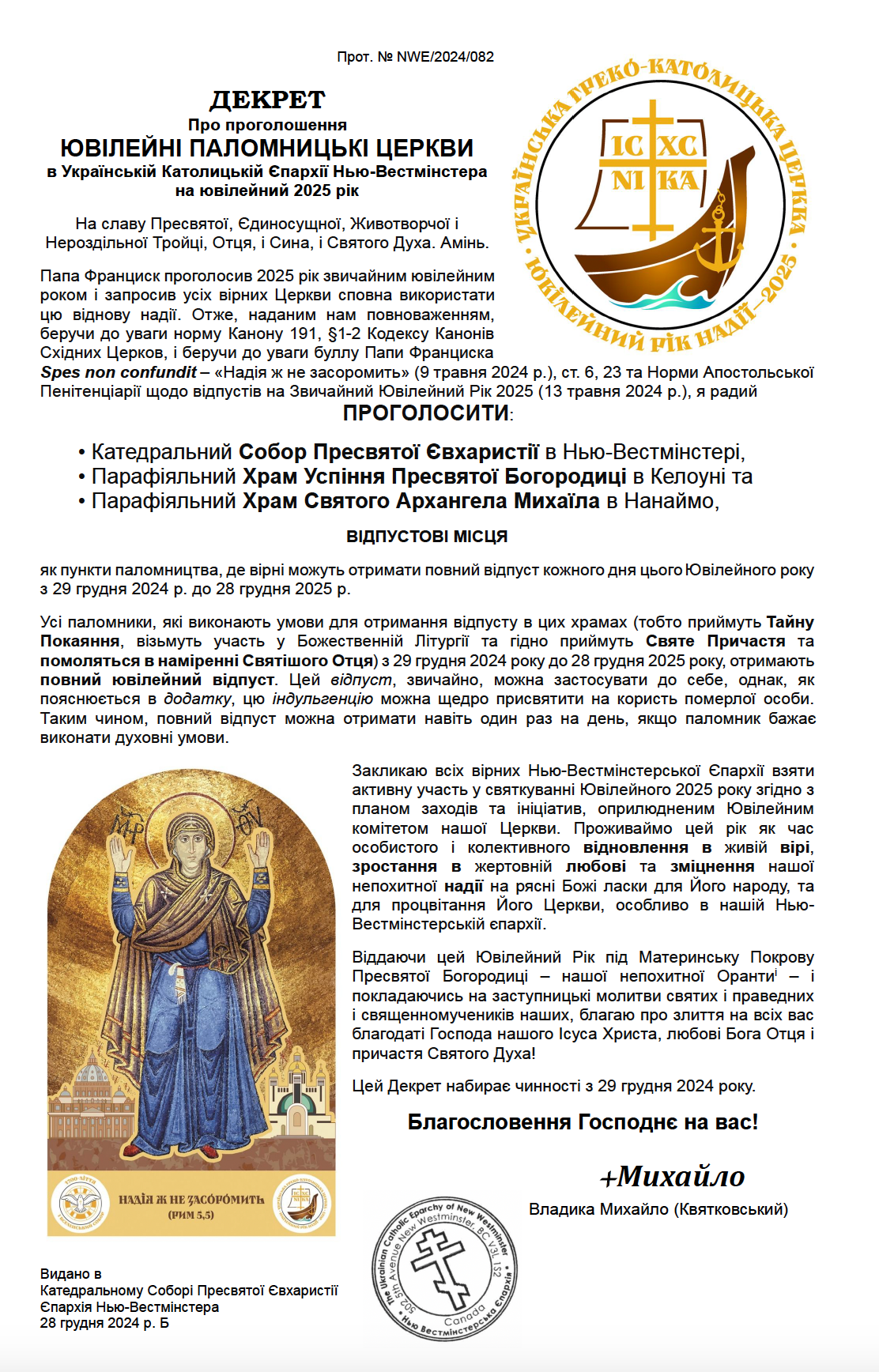
в Українській Католицькій Єпархії Нью-Вестмінстера на ювілейний 2025 рік
На славу Пресвятої, Єдиносущної, Животворчої і Нероздільної Тройці, Отця, і Сина, і Святого Духа. Амінь.
Папа Франциск проголосив 2025 рік звичайним ювілейнимроком і запросив усіх вірних Церкви сповна використатицю віднову надії. Отже, наданим нам повноваженням, беручи до уваги норму Канону 191, §1-2 Кодексу КанонівСхідних Церков, і беручи до уваги буллу Папи Франциска Spes non confundit – «Надія ж не засоромить» (9 травня 2024 р.), ст. 6, 23 та Норми Апостольської Пенітенціарії щодо відпустів на Звичайний Ювілейний Рік 2025 (13 травня 2024 р.), я радий
ПРОГОЛОСИТИ:
• Катедральний Собор Пресвятої Євхаристії в Нью-Вестмінстері,
• Парафіяльний Храм Успіння Пресвятої Богородиці в Келоуні та
• Парафіяльний Храм Святого Архангела Михаїла в Нанаймо,
ВІДПУСТОВІ МІСЦЯ
як пункти паломництва, де вірні можуть отримати повний відпуст кожного дня цього Ювілейного рокуз 29 грудня 2024 р. до 28 грудня 2025 р.
As Mother and Teacher, the Church labours to bring the Gospel to the world in every age and continually draws on the rich legacy of faith and service that has guided her mission through the centuries. The apostolate of Catholic education is a treasured part of this tradition. It is essential to the Church’s “identity and mission.”[1]
“Catholic schools, which always strive to join their work of education with the explicit proclamation of the Gospel, are a most valuable resource for the evangelization of culture.”[2] They are integral to the parish, participating in the Church’s evangelizing mission.[3] They provide religious and moral reference points to assist students to critically evaluate culture in the light of the Gospel and contribute to building a social order enlightened by the truth of Christ’s teaching. This light is directed not only to the individual but also to the community: the work of evangelization addresses persons, families and cultures.
The world in which our schools carry out their mission is marked by an unhealthy individualism that often leads to an eclipse of community identity. The subjectivism and moral relativism that accompany this cultural shift have increasingly marginalized faith as a reference point for human life. Due to advancing secularization, Catholic schools find themselves in a missionary situation, which calls them to bear witness through a community and life clearly inspired by the Gospel.[4]
In this new reality, the school performs an important role for students and families. “The school is a centre in which a specific concept of the world, of [the human person] and of history is developed and conveyed.”[5] “Knowledge set in the context of faith becomes wisdom and life vision.”[6]
“Christ is the foundation of the whole educational enterprise in a Catholic school.”[7] His teaching and life inform the school’s identity and characteristics. His sacramental gifts build up the community and prepare its members for a share in the mission to bring His light to every person and situation. “The special character of the Catholic school and the underlying reason for its existence, the reason why Catholic parents should prefer it, is precisely the quality of the religious instruction integrated into the overall education of the students.”[8]
Teaching the Whole Person
Because “promotion of the human person is the goal of the Catholic school,”[9] Catholic education goes beyond the technical and practical aspects of schooling to help students integrate every area of knowledge within a Christian vision of the human person. The school recognizes that the physical, emotional, moral, and spiritual dimensions of human development must tend to a personal synthesis of faith and life in each student. Growth in these areas prepares students for a life of service, building the Kingdom of God in society.
Faith and Life Shared in a Community
The Catholic school is a place of ecclesial experience. The New Testament speaks of the Church as koinonia, a communion of relationships built through sharing life in Christ. This communion fosters relationships characterized by mutual respect, open communication through a culture of dialogue and the commitment to serve each other’s needs. Throughout history, the Church’s educational mission has been distinguished by its unwavering concern for the poor and marginalized, reflecting the Gospel’s call to compassion and justice. In this spirit, all members of the school community are called to recognize, respect and actively bear witness to the school’s Catholic identity.
Parents
The parish is a family of families. Through its school, the parish cooperates with parents to support them in their role as the primary educators of their children, especially in transmitting the faith.[10] Through the school, parents and children are linked to the broader community of the parish. Parents should be involved in the life of the school by participating in councils and committees, as well as by regularly collaborating with the staff.
Staff
“Teachers and educators fulfil a specific Christian vocation and share an equally specific participation in the mission of the Church.”[11] Staff members are called to model the integration of faith and culture in all the subjects they teach. Their responsibility extends “to the moral, spiritual and social aspects of life.”[12] “Professionalism is marked by, and raised to, a supernatural Christian vocation.”[13] It is the teachers’ personal witness that will have the most significant impact on the students. They are to inspire others “by their evident love of Christ, their witness of sound devotion and their commitment to that Christian wisdom which integrates faith and life, intellectual passion and reverence for the splendour of truth both human and divine.”[14]
The leadership of the school community should promote the effectiveness of those who teach by providing ongoing professional development and formation in the Catholic faith.
Pastors
The pastor is an integral member of the school community, with a specific role in overseeing the religious education curriculum and leading the liturgical life. He is responsible for supporting the formation of teachers in their role as Catholic educators. He should promote Catholic education, especially for those who are poor, deprived of the benefits of family life or otherwise marginalized.
Conclusion
St. John Paul II called for evangelization in the third millennium “new in its ardour, methods and expressions.”[15] Drawing on the rich tradition of the educational apostolate, our schools should continually assess their progress in living out this call to mission. “It is not merely a question of adaptation, but of missionary thrust, the fundamental duty to evangelize.”[16] Catholic schools “constitute a very valid contribution to the evangelization of culture.”[17] The gifts and creativity of every community member help our Catholic schools find new and effective ways of evangelizing and forming young people and their families for life and the Church’s evangelizing mission.
Given on the Memorial of Saint Thomas Aquinas, the 28th day of January, in the Year of Our Lord, Two Thousand and Twenty-five.
The Catholic Bishops of British Columbia
✠ Most Rev. J. Michael Miller, CSB, Archbishop of Vancouver ✠ Most Rev. Gary Gordon, Bishop of Victoria ✠ Most Rev. Stephen Jensen, Bishop of Prince George ✠ Most Rev. Gregory Bittman, Bishop of Nelson ✠ Most Rev. Joseph Phuong Nguyen, Bishop of Kamloops ✠ Most Rev. Michael Kwiatkowski, Ukrainian Catholic Bishop of New Westminster
[1]Congregation for Catholic Education, The Identity of the Catholic School for a Culture of Dialogue (25 January 2022), n. 10.
[2]Francis, Evangelii Gaudium (24 November 2013), n. 134.
[3] Cf. Congregation for Catholic Education, The Catholic School on the Threshold of the Third Millennium (28 December 1997), n. 11.
[4] Congregation for Catholic Education, The Identity of the Catholic School for a Culture of Dialogue (25 January 2022), n. 28.
[5] Sacred Congregation for Catholic Education, The Catholic School (19 March 1977), n. 8.
[6] Congregation for Catholic Education, The Catholic School on the Threshold of the Third Millennium (28 December 1997), n. 14.
[7] Sacred Congregation for Catholic Education, The Catholic School (19 March 1977), n. 34.
[8] Congregation for Catholic Education, The Religious Dimension of Education in a Catholic School (7 April 1988), n. 66.
[15] St. John Paul II, Address at the Opening of the 19th Ordinary Plenary Assembly of the Latin American Episcopal Conference (9 March 1983).
[16] Congregation for Catholic Education, The Catholic School on the Threshold of the Third Millennium (28 December 1997), n. 3.
[17] Congregation for Catholic Education, The Identity of the Catholic School for a Culture of Dialogue (25 January 2022), n. 95.ic Education, The Identity of the Catholic School for a Culture of Dialogue (25 January 2022), n. 95.
Recent Comments