History of the Ukrainian Greek Catholic Church
Історія Української Греко-Католицької Церкви
| 1. The birth of Christianity in Ukrainian lands | 1. Зародження християнства на теренах України |
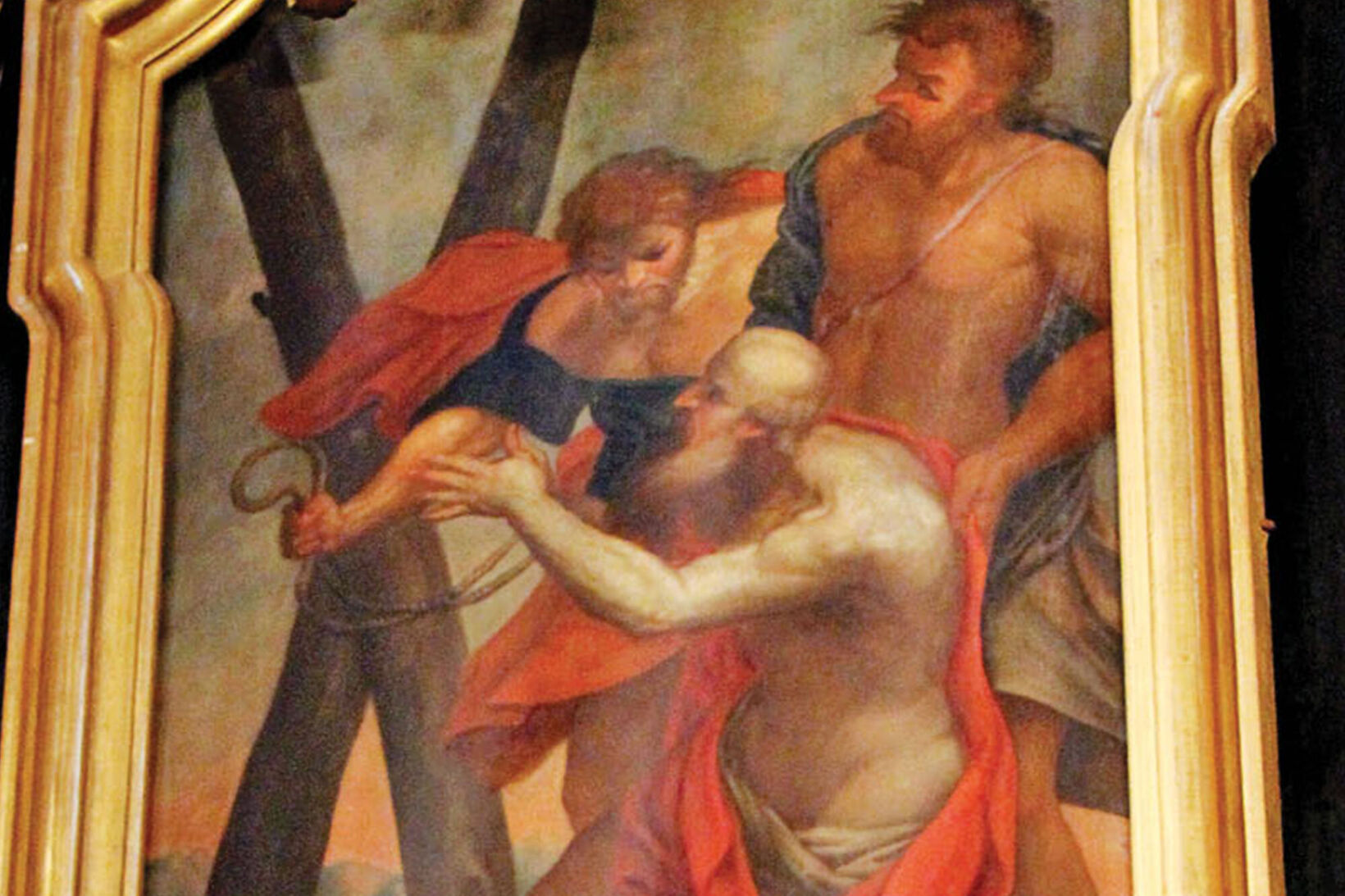
Icon of St. Andrew the First-Called / Ікона св. Андрія Первозванного
|
|
| English | Українська |
|
The first Christians appeared on the territory of Ukraine during the first Christian missions at the turn of the 1st — 2nd centuries. According to chronicle tradition, Holy Apostle Andrew the First-Called visited our lands — what was then Scythia — undertaking missionary activities. He blessed the lands above the Dnipro, where in a few centuries the center of Christianity and Christian culture of the Eastern Slavs would be founded — Kyiv. |
Перші християни з'явилися на території України в часи перших християнських місій на зламі І-ІІ століть. За літописною легендою, місійну діяльність на наших землях — у тодішній Скіфії — проводив ще Святий апостол Андрій Первозванний. Він благословив землі над Дніпром, де через кількасот років постав Київ — центр християнства та християнської культури східних слов'ян. |
|
The chronicles say that the Apostle Andrew ascended the hills of Kyiv to declare, "Believe me that the grace of God will shine the light upon these hills: a great city will rise here, and the Lord will erect many churches there and enlighten the Rus' lands with church baptism." |
Згідно з літописом, апостол Андрій дійшов до Київських гір, де проголосив: «Вірте мені, що на цих горах возсіяє благодать Божа; велике місто буде тут, і Господь воздвигне там багато церков і просвітить церковним хрещенням усю руську землю». |
|
There is evidence that some Scythians adopted Christianity, and that there even were Scythian bishops. Christianity was the most widespread, however, amongst the Greeks who inhabited southern Ukraine at that time. Roman emperors exiled Christians to the Greek settlements of Tyre, Olbia, Chersonesos, and it is they who became the first preachers of the Gospel there. |
Збереглися свідчення про те, що християнство прийняла частина скіфів, зустрічаються навіть згадки про скіфських єпископів. Особливо поширювалося воно серед греків, що тоді населяли Південну Україну. У грецькі поселення Тіру, Ольвію, Херсонес та інші міста римські імператори висилали християн, які стали першими проповідниками Євангелія. |
|
The most famous of these "Ukrainian Greeks" was Pope Clement of Rome, author of the First Letter to the Corinthians, whom Emperor Trajan exiled to Chersonesos, one of the largest Greek colonies, and who was martyred there. According to the testimony of the early Christian writer Irenaeus, St. Clement was the fourth successor of the Apostle Peter in the See of Rome. |
Найвідомішим серед них був засланий імператором Траяном до Херсонеса — однієї з найбільших грецьких колоній — Папа Климентій римський, автор листа до Коринтян, який загинув тут мученицькою смертю. Відповідно до свідчень ранньохристиянського письменника Іринея Ліонського, Святий Климентій був четвертим наступником апостола Петра на римському престолі. |
|
When Clement arrived in Chersonesos, he found many Christians residing there. Through his missionary efforts many pagans turned to the Christian faith in a short period of time, and numerous temples were built. His evangelizing led to his martyrdom in the year 100. |
Климентій, прибувши до Херсонеса, знайшов там багато християн. Завдяки його місії за короткий час чимало язичників повернулися до християнської віри, постали численні храми. Саме активна пастирська діяльність стала причиною його мученицької смерті в 100-му році. |
|
The cult of St. Clement spread in Rus' after the brothers Saints Cyril and Methodius of Thessalonica, found his relics in 861. This fact is closely related to the Slavic mission of the holy brothers. They brought part of the relics to Rome in 867 and gave them to Pope Adrian II, who became a symbol of reconciliation between the Churches of the East and the West. |
Культ Святого Климентія в Русі поширився після того, як його мощі були віднайдені солунськими братами Кирилом і Методієм у 861 році. Цей факт тісно пов'язаний із хозарською місією святих братів. Частину мощів вони перенесли до Рима у 867 році та передали Папі Адріану ІІ, що виглядало як символ примирення між Церквою Сходу та Заходу. |
|
Archaeological finds from the 3rd century indicate the presence of Christian communities in the Bosphoran Kingdom: in the 4th century a separate Bosporus diocese was already functioning. Their bishop, Cadmus I, took part in the Ecumenical Council of Nicaea in the year 325. |
Окремі археологічні знахідки ІІІ століття свідчать про наявність християнських громад у Боспорському царстві, а в ІV столітті існувала окрема Боспорська єпархія, єпископ якої — Кадмус — узяв участь у I Вселенському Соборі в Нікеї 325 року. |
|
The introduction of Christianity as the state religion of the Roman Empire in the late 4th — early 5th centuries further contributed to its spread among the population of Crimea. By that time, a diocese had already been established in Chersonesos, whose bishop was a member of the Second Ecumenical Council of Constantinople in 381. |
Запровадження християнства як державної релігії Римської імперії наприкінці ІV століття сприяло його активному поширенню серед населення Криму. На той час уже була створена єпархія в Херсонесі, а її єпископ став учасником ІІ Вселенського Собору в Константинополі 381 року. |
|
The adoption of Christianity in Crimea dates back to the late 5th — early 6th centuries. In the 3rd century Germanic tribes entered the territory of Ukraine and sometime during 341–348 they were converted to Christianity by Bishop Ulfilas, who translated the Gospel into the Gothic language. During the 4th–5th centuries Slavic tribes spread over the territory of Ukraine, particularly to the trans-Dnipro Polian tribal lands with their center being in Kyiv. |
Утвердження християнства в Криму датується кінцем V — початком VІ століття. У ІІІ столітті на територію України прийшли германські племена готів, які в 341–348 роках прийняли християнство від єпископа Вульфіли, котрий переклав Євангеліє готською мовою. А в ІV—V століттях по території України розселилися слов'янські племена, зокрема в Наддніпрянщині поляни — з центром у Києві. |
| 2. Spread of the Christian Faith before Volodymyr (9th–10th centuries) | 2. Поширення християнської віри до Володимира (ІХ-Х століття) |
Askold's Baptism / Хрещення Аскольда
|
|
| English | Українська |
|
The formation of the Kyivan state is closely intertwined with the spread of Christianity on Ukrainian territories. According to Photius, Patriarch of Constantinople, and the Byzantine chroniclers, in 860 Prince Askold of Kyiv and his entourage were baptized (received the "first baptism of Rus'") during the campaign against Constantinople, and invited missionaries to Kyiv. |
Становлення Київської держави тісно переплетене з поширенням християнства на українських територіях. За свідченнями Константинопольського патріарха Фотія та візантійських хроністів, 860 року під час походу на Константинополь київський князь Аскольд зі своїм оточенням охрестився («перше хрещення Русі») і запросив місіонерів до Києва. |
|
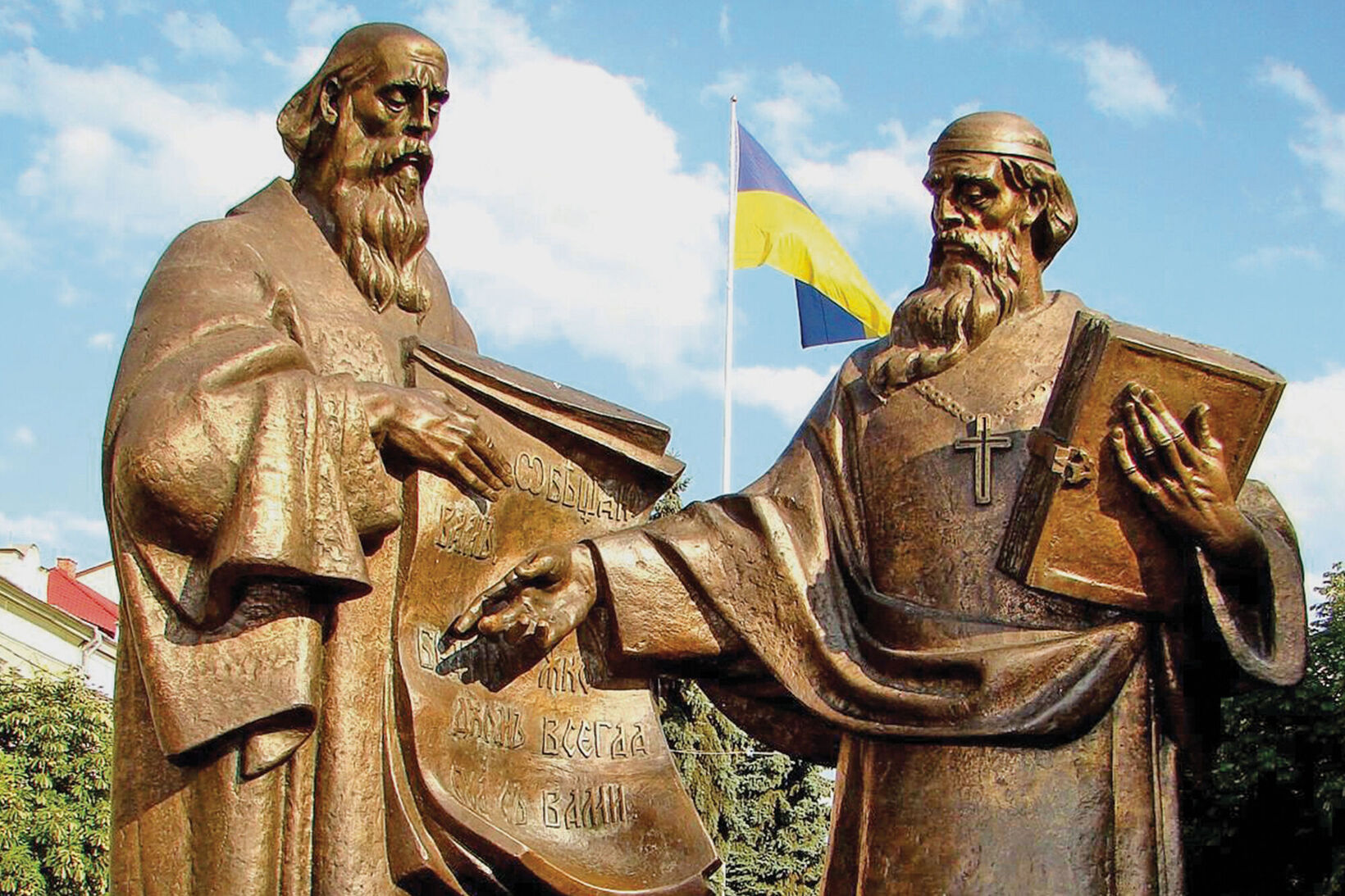
The missionary work of Cyril and Methodius also had a decisive influence on this process starting from the 9th century. The city of Thessalonica (Solun), where the brothers were born, was very close to Slavic lands. Cyril studied in Constantinople at the court of the Byzantine Emperor Michael III and knew Slavonic, Greek, Latin, Hebrew, and Arabic languages. |
Визначну роль у поширенні християнства відіграла діяльність святих Кирила й Методія. Місто Тесалоніки (Солунь), у якому народилися брати, знаходилося в безпосередній близькості до слов'янських земель. Кирило навчався в Константинополі при дворі візантійського імператора Михайла III, добре знав слов'янську, грецьку, латинську, єврейську, арабську мови. |
|
On the invitation of Prince Rostislav of Greater Moravia and with the consent of Emperor Michael III and Patriarch Ignatius, the brothers commenced their missionary work, preaching Christianity to the people of Greater Moravia. The success of the endeavor was facilitated by the fact that before leaving for Moravia, Cyril created a Slavic alphabet to help translate the Holy Scriptures. |
На запрошення моравського князя Ростислава і за згодою імператора Михайла III та патріарха Ігнатія брати розпочали свою місійну діяльність, проповідуючи християнство народам Великої Моравії. Успіхові проповіді сприяло те, що Кирило створив слов'янську абетку для перекладу Святого Письма. |
|
Through a language understood by the Slavs, the Christian faith began to spread rapidly not only in Greater Moravia, but also among the neighboring Slavic tribes, particularly in Poland and Western Rus'. Moreover, the translational activity of Saints Cyril and Methodius contributed to the further development of Slavic culture in general. "Old Slavonic" for centuries became not only the Church language, but also the official literary language used by the educated strata of society. |
Завдяки зрозумілій для слов'ян мові християнська віра почала швидко поширюватися не лише у Великій Моравії, а й серед сусідніх слов'янських племен, зокрема в Польщі та Західній Русі. Крім того, перекладацька діяльність святих Кирила й Методія сприяла подальшому розвиткові слов'янської культури загалом. «Старослов'янська» на довгі століття стала не лише церковною мовою, а й офіційною літературною мовою освічених верств суспільства. |
|
Saints Cyril and Methodius are recorded in history as the "bridges" that united the Slavic peoples with the Catholic Church. By that time, the differences between Rome and Constantinople were heating up and led to fierce polemical debates in church literature. However, the activities of the holy brothers had a conciliatory nature. They sought compromise and believed that disputes should be resolved through dialogue. |
Святі Кирило і Методій увійшли в історію як «містки», що єднають слов'янські народи з Католицькою Церквою. Уже в той час різниця між Римом та Константинополем була доволі помітна, вони вели між собою гостру полеміку в церковній літературі. Водночас діяльність святих братів мала примирливий характер. Вони шукали порозуміння і вважали, що суперечки слід вирішувати через діалог. |
|
On November 30, 1880, Pope Leo XIII formally introduced the feast day of Saints Cyril and Methodius into the Western Church, emphasizing their universal significance. On December 31, 1980 Pope John Paul II declared Saints Cyril and Methodius, together with Saint Benedict, the spiritual patrons of Europe. |
30 листопада 1880 року Папа Лев ХІІІ офіційно запровадив день свята святих Кирила і Методія в Західній Церкві, підкресливши їхнє вселенське значення. 31 грудня 1980 року Папа Іван Павло II проголосив святих Кирила і Методія разом зі святим Бенедиктом духовними покровителями Європи. |
| 3. Baptism of Rus'-Ukraine 988 | 3. Хрещення Русі-України (988) |
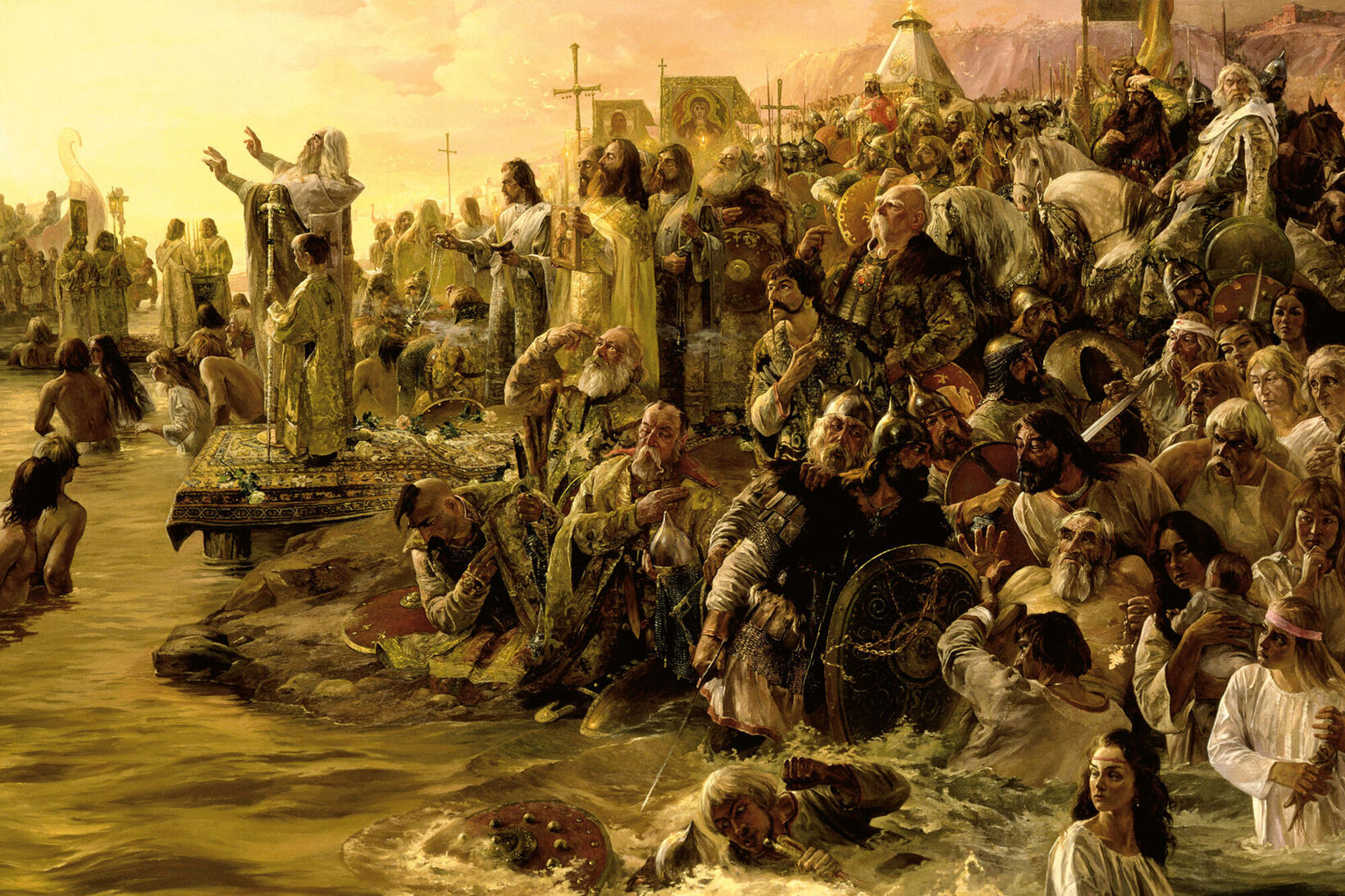
Saints Volodymyr and Olha / Святі Володимир та Ольга
|
|
| English | Українська |
|
Before Prince Volodymyr's reign, Christianity had no official status in Rus', although Kyivan princes, beginning from Askold, either themselves converted to Christianity or were tolerant of the Christian faith. For the year 944, during the reign of Prince Ihor (912–945), chronicles mention a St. Elijah church in Kyiv's Podil district. Ihor's wife, Princess Olha (945–969) was baptized in Constantinople circa 957. |
До правління князя Володимира християнство не мало офіційного статусу в Русі, хоча київські князі, починаючи від Аскольда, або самі приймали християнство, або ставилися до християнської віри толерантно. Під 944 роком, за правління князя Ігоря (912–945), літописи згадують церкву святого Іллі в київському Подолі. Дружина Ігоря княгиня Ольга (945–969) охрестилася в Константинополі близько 957 року. |
|
However, the decisive step for the future and identity of the Church in the East Slavic lands was the adoption of Christianity of the Eastern rite as the state religion in 988, during the reign of the grandson of Prince Ihor and Olha, Volodymyr the Great (978–1015). |
Визначальним, проте, для подальшої долі та ідентичності Церкви на східнослов'янських землях стало прийняття християнства в східному обряді як державної релігії приблизно 988 року під час правління внука князя Ігоря та княгині Ольги — Володимира Великого (978–1015 рр.). |
|
While the Chronicle of Nestor reports that the Prince sent envoys to representatives of various religions and ultimately accepted Christianity, the decision was not accidental. Besides religious reasons, an important role in the adoption of Christianity was the political and cultural expediency of such a step, since Christianity played a key role in what was then the civilized part of the world. |
Хоча, відповідно до літопису Нестора, князь посилав своїх посланців до представників різних релігій, його вибір зупинився саме на християнській. Таке рішення не було випадковим. Окрім релігійних мотивів, важливу роль у прийнятті християнства відіграла політична та культурологічна доцільність такого кроку, адже християнство в тогочасному цивілізованому просторі відігравало ключову роль. |
|
The adoption of Christianity ensured moral prestige for Prince Volodymyr and his state, giving it a legitimate status among other nations and rulers, and thereby changing their attitude towards Rus'. The baptism of the Eastern Slavs who lived within the Kyivan state at that time, facilitated the rapid spread of a written culture. |
Прийняття християнства забезпечило князю Володимиру та його державі моральний престиж, надало їй законного статусу серед інших народів і правителів, змінивши тим самим їхнє ставлення до Русі. Хрещення східних слов'ян, що проживали в межах Київської держави, сприяло швидкому поширенню писемної культури. |
|
For Grand Prince Volodymyr, the formal baptism of Rus' was not an end in itself. Having changed his ways (in his youth he was prideful and imperious, leading a reckless and bloody tyrannical life) he became engaged in the formal enlightenment of the masses. He built temples, supported literary crafts, founded libraries, and supported schools. |
Для великого князя Володимира офіційне хрещення Русі не було самоціллю. Змінивши свій спосіб життя (у молодості він був гордовитий і владний, вів безтурботне й кровопролитне тиранічне життя), він почав займатися офіційним просвітництвом мас. Він будував храми, підтримував книжкову справу, засновував бібліотеки та школи. |
|
The Kyivan Metropolia enjoyed a golden age during the reign of another of Volodymyr's sons, Yaroslav the Wise (1019–1054), when "the Christian faith began to multiply and spread." The prince initiated the construction of Kyiv's majestic monasteries and churches, completed construction of the Cathedral of St. Sophia, which had been commenced by his father. |
Київська митрополія переживала золоту добу за правління іншого сина Володимира — Ярослава Мудрого (1019–1054), коли «християнська віра почала множитися і поширюватися». Князь започаткував будівництво величних київських монастирів і церков, завершив зведення Софійського собору, розпочате ще його батьком. |
|
The Kyivan Metropolia faced significant changes that occurred as a result of the gradual disintegration of the state into separate principalities and the violent struggle of the many descendants of the Rurik dynasty for the "Kyiv heritage." After the invasion of the Mongol Horde in 1240, rulers from neighboring states joined the fight. |
Київська митрополія зазнала значних змін внаслідок поступового розпаду держави на окремі князівства та жорстокої боротьби численних нащадків династії Рюриковичів за «київську спадщину». Після навали монгольської Орди 1240 року до боротьби долучилися правителі сусідніх держав. |
| 4. Union of Brest 1596 | 4. Берестейська унія (1596) |
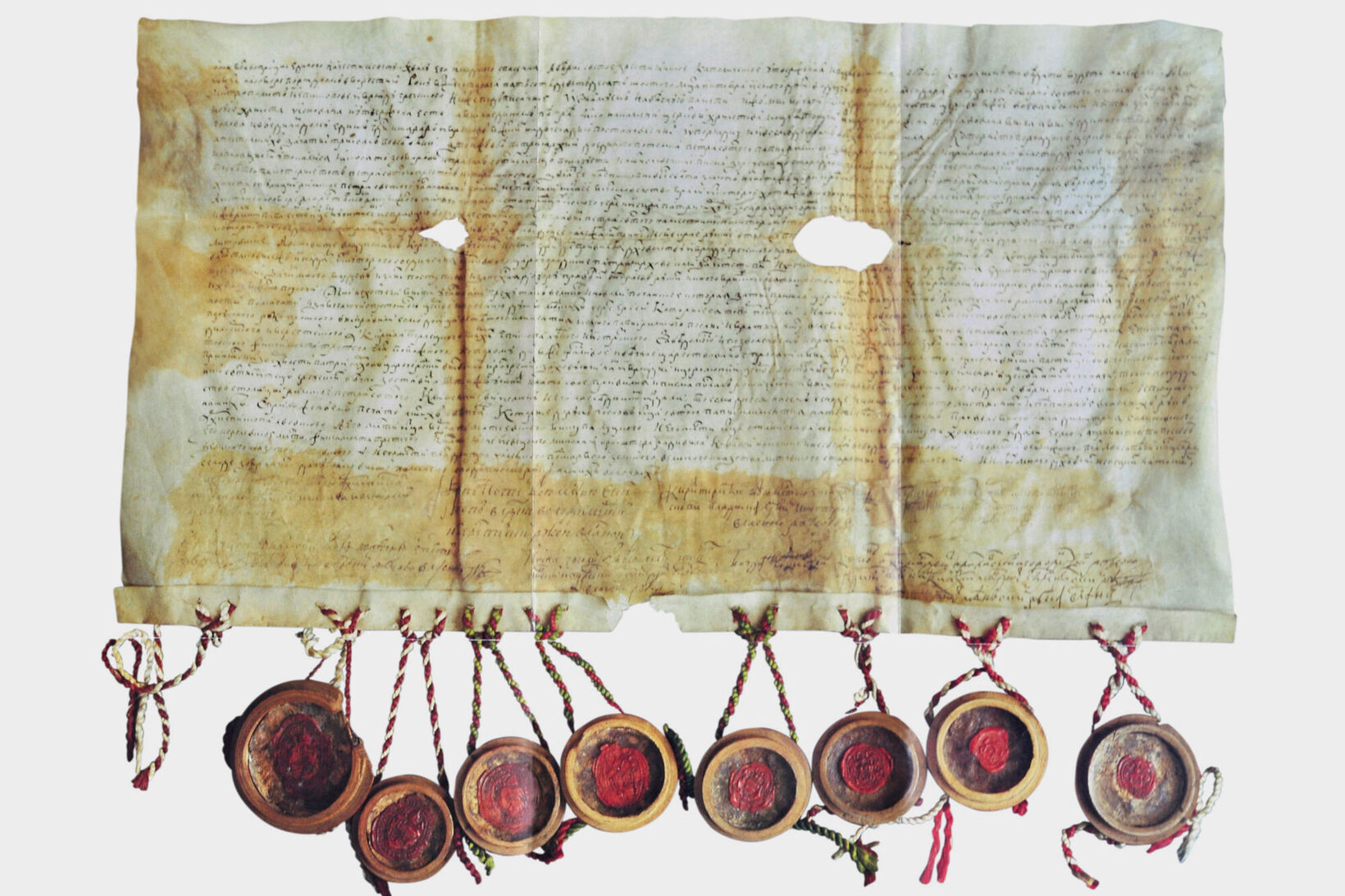
The Brest Declaration / Берестейська Грамота
|
|
| English | Українська |
|
The decline of the ancient state under pressure from the Mongol Horde and the transfer of a large part of Rus' lands to Polish and Lithuanian rule in the 14th century led to the displacement of the Metropolitan See of Kyiv and attempts to divide it. However, being on the border of East and West Europe, the ecclesiastical elites took repeated steps to restore Christian unity. |
Занепад давньоруської держави під натиском орди та перехід у XIV столітті значної частини її земель під владу польських і литовських правителів призвели до переміщення осідку Київської митрополії та спроб її поділу. Водночас, перебуваючи на пограниччі європейського Сходу і Заходу, руська церковна еліта неодноразово робила кроки до відновлення християнської єдності. |
|
The Florentine Union between Rome and Constantinople in 1439 received a positive reception in what is now the Ukrainian and Belarus lands. One of the founders of the Union was Metropolitan Isidore of Kyiv. The Pope elevated him to the dignity of cardinal and appointed him legate to Poland, Lithuania and Muscovy. |
Флорентійська унія між Римом і Константинополем 1439 року була позитивно сприйнята на теренах сучасної України та Білорусі. Одним із засновників унії був Київський митрополит Ісидор. Папа підніс його до гідності кардинала і призначив легатом у Польщу, Литву і Московію. |
|
At the end of the 16th century, the bishops of the Kyivan Metropolia made a Synodal decision to reestablish communion with the Apostolic See of Rome. Thus, the Union of Brest was concluded in 1596. The visionaries of the union aimed not only to preserve the traditional church structure and eastern (Byzantine) rite, but also to resist assimilation and conversion of Ukrainian and Belorussian eastern rite Christians to Polish Roman Catholicism. |
Руський єпископат наприкінці XVI століття прийняв синодальне рішення перейти під опіку та захист Римського Апостольського престолу. Так, було укладено Берестейський унійний акт 1596 року, який ознаменував відновлення сопричасної єдності Київської Церкви з Латинською. Архітектори церковного порозуміння мали на меті не лише зберегти традиційний церковний устрій, східний (візантійський) обряд, а й протистояти асиміляції українців та білорусів чи переходові на римо-католицизм. |
|
The bishops of the Kyivan Metropolia chose the first project, which they believed to be more realistic, and on December 23, 1595 delegated two bishops, Ipatiy Potiy and Cyril Terlecki, to travel to Rome to present the proposal to Pope Clement VIII. |
Єпископи Київської митрополії обрали перший проект, який вважали більш реалістичним, і 23 грудня 1595 року направили двох єпископів — Іпатія Потія та Кирила Терлецького — до Рима, щоб представити пропозицію Папі Климентію VIII. |
|
In Halychyna (Galicia), where Polish-Ukrainian antagonism was particularly tense, union with Rome was resisted for almost a century. The Przemysl Eparchy accepted the union only 1691, while the Lviv Eparchy — in 1700. The Synod of Zamość institutionalized the status of the Uniate Church, as this union was called, in 1720 as the only eastern rite Church in the lands of the Commonwealth. |
У Галичині, де польсько-український антагонізм відзначався особливою гостротою і напруженням, з'єднана з Римом Церква здобула прихильність православної ієрархії та вірних майже через століття після Берестя (лише в 1691 р. прийняла унію Перемишльська єпархія і аж у 1700-му — Львівська). Синод у Замості 1720 року закріпив за Унійною Церквою статус єдиної Церкви східного обряду на землях Речі Посполитої. |
| 5. Restoration of the Galician Metropolitanate 1808 | 5. Відновлення Галицької митрополії (1808) |
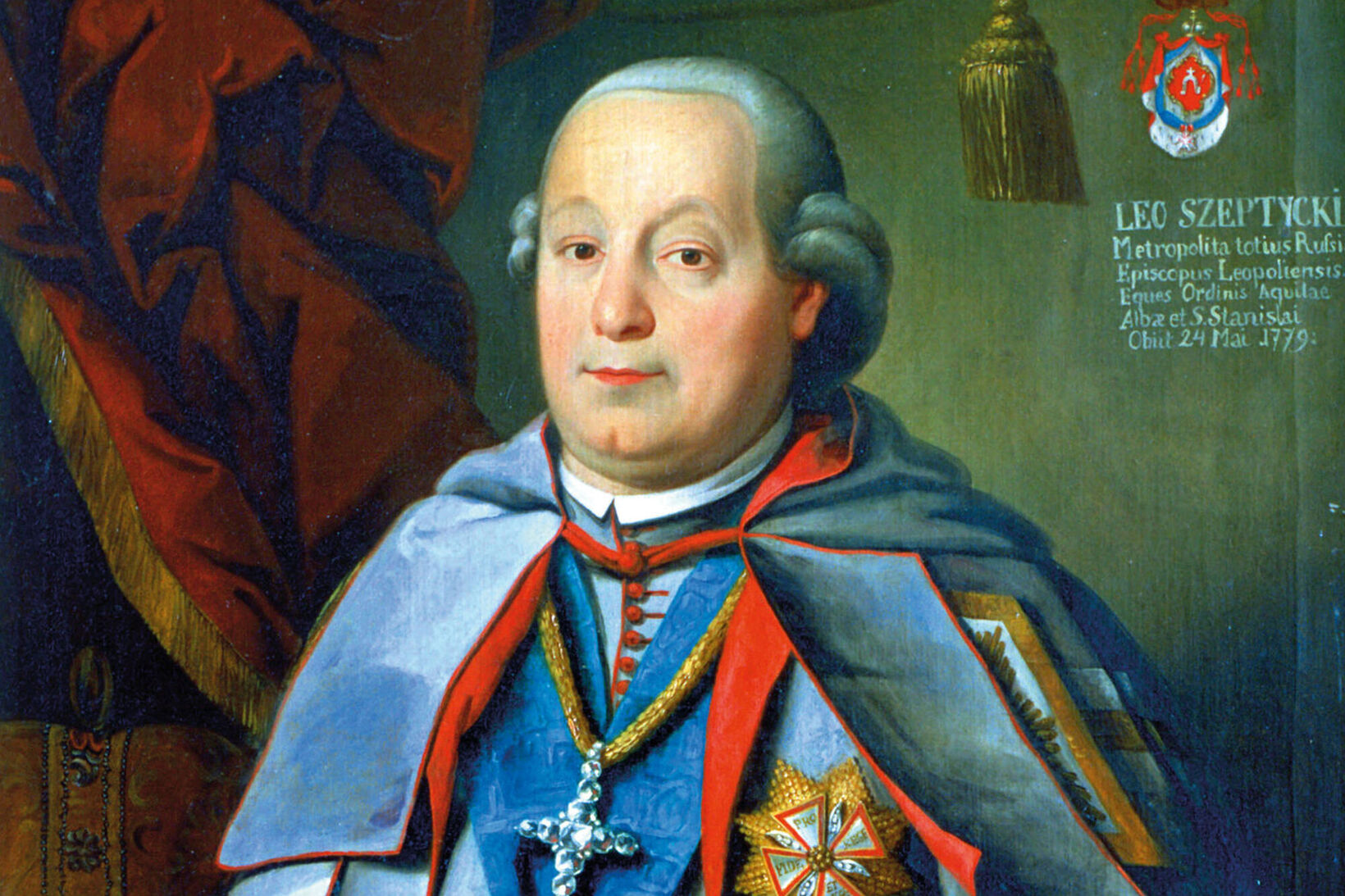
Metropolitan Lev Sheptytsky / Митрополит Лев Шептицький
|
|
| English | Українська |
|
The strengthening of Ukrainian (Ruthenian) Church in the Commonwealth did not last for long. After the weakening and division of the country in 1772, 1793 and 1795, the Russian Empire extended its power to neighbouring Ukrainian lands, accompanying it with repression against the "Uniates" and forced "conversion" to the Moscow Church. |
Утвердження Української (Руської) Церкви в Речі Посполитій не було тривалим. Через ослаблення та поділи держави в 1772-му, 1793-му й 1795 роках Російська імперія поширювала свою владу на суміжні українські землі, супроводжуючи це репресіями проти «уніатів» та насильницьким «наверненням» їх у Московську Церкву. |
|
Meanwhile, the idea of Orthodox-Catholic church unity gained more supporters in the western part of Ukraine. At the Uzhhorod Council of 1646 a part of the clergy from the Eparchy of Mukachevo, an area which for centuries was under Hungarian rule, decided to restore communion with Rome. |
Тим часом ідея православно-католицької церковної єдності здобувала все більше прихильників у західній частині України. На Ужгородському соборі 1646 року частина духовенства Мукачівської єпархії, яка протягом століть перебувала під угорським правлінням, вирішила відновити сопричастя з Римом. |
|
The educational policy of the Habsburgs was critically important in changing the nature of the relationship between Christians of different traditions — first in Transcarpathia and later in Galicia, which after the first partition of Poland (1772) passed to the Austrian monarchy. |
Освітня політика Габсбургів мала вирішальне значення для зміни характеру відносин між християнами різних традицій — спочатку в Закарпатті, а згодом у Галичині, яка після першого поділу Польщі (1772) перейшла до австрійської монархії. |
|
1808 saw the restoration of the Galician Metropolitanate with the center in Lviv. The Habsburg reforms strengthened the principles of tolerance, respect for freedom of conscience, and the integration of Ukrainian Christians and their religious structures into public and political life. |
1808 року було відновлено Галицьку митрополію з центром у Львові. Габсбурзькі реформи зміцнили принципи толерантності, поваги до свободи совісті та інтеграції українських християн та їхніх релігійних структур у суспільне та політичне життя. |
|
The Greek-Catholic Church in Galicia played a special role in the Ukrainian national movement. Although most of the Greek-Catholic clergy were polonized in the late 18th — early 19th century, some of the lower clergy and seminarians under the influence of the "Ruthenian Triad" — Markiyan Shashkevych, Ivan Vahylevych and Yakiv Holovatsky, drew public attention to the common people in the 1830's. |
Греко-Католицька Церква в Галичині відіграла особливу роль в українському національному русі. Хоча більшість греко-католицького духовенства була полонізована наприкінці XVIII — на початку XIX століття, частина нижчого духовенства та семінаристів під впливом «Руської Трійці» — Маркіяна Шашкевича, Івана Вагилевича та Якова Головацького — звернула увагу суспільства на простий народ у 1830-х роках. |
|
1868 saw the creation of the society Prosvita (Enlightenment), which engaged the Ukrainian peasantry in educational work. Every town and village had local chapters of Prosvita with reading rooms led by local priests. The most prominent Ukrainian socio-political and cultural figures were often members and alumni of this organization. |
1868 року було створено товариство «Просвіта», яке залучало українське селянство до просвітницької роботи. У кожному місті та селі діяли місцеві осередки «Просвіти» з читальнями, які очолювали місцеві священики. Найвидатніші українські суспільно-політичні та культурні діячі часто були членами й вихованцями цієї організації. |
| 6. Metropolitan Sheptytsky 1865–1944 | 6. Митрополит Андрей Шептицький (1865–1944) |
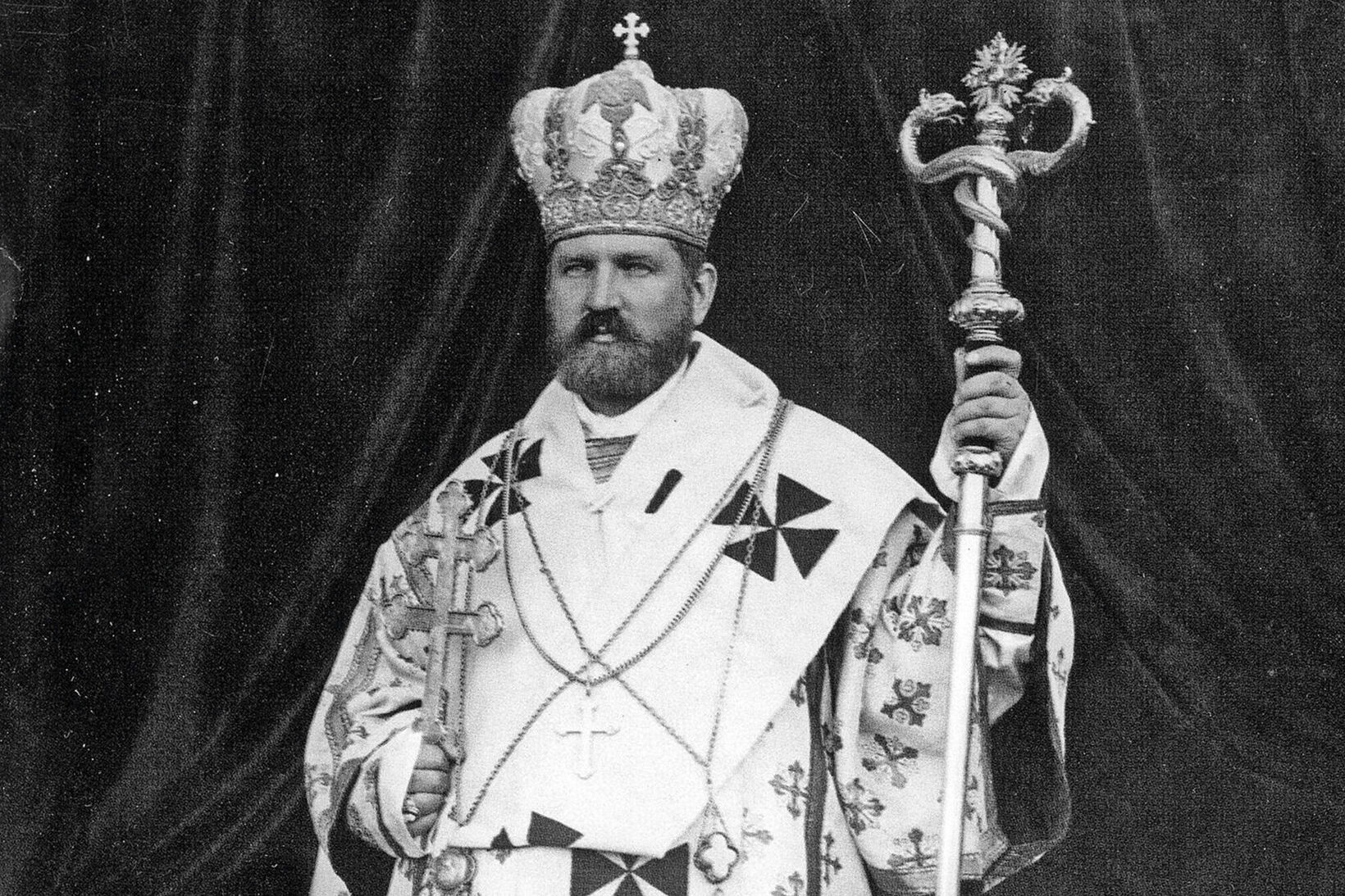
Metropolitan Andrey Sheptytsky / Митрополит Андрей Шептицький
|
|
| English | Українська |
|
The life and work of Metropolitan Sheptytsky had a tremendous impact on the Ukrainian Church. He was one of the first bishops of the UGCC to begin using the Ukrainian vernacular to communicate with the faithful. Under his leadership, the Greek-Catholic Church became an extensive and influential institution, an important agent of consolidation and spiritual support in the struggle for Ukrainian statehood. |
Життя та діяльність митрополита Андрея справили величезний вплив на розвиток Української Церкви. Він був одним із перших єпископів УГКЦ, який почав використовувати українську народну мову для спілкування з вірними. Під його керівництвом Греко-Католицька Церква стала потужною та впливовою інституцією, важливим чинником консолідації та духовної підтримки в боротьбі за українську державність. |
|
Metropolitan Sheptytsky was born into an old Ukrainian family. After entering the Basilian monastery in Dobromyl in 1888, he took the monastic name Andrew. He studied philosophy and theology in Krakow and then law in Munich, earning doctoral degrees in Theology and Philosophy. In 1899 Sheptytsky was nominated bishop of the Stanislav eparchy and in 1900 — Metropolitan of Galicia. |
Митрополит Шептицький народився в давньому українському роді. Вступивши до Василіанського монастиря в Добромилі 1888 року, він прийняв чернече ім'я Андрей. Вивчав філософію та богослов'я в Кракові, а потім право в Мюнхені, здобувши докторські ступені з богослов'я та філософії. У 1899 році Шептицького призначено єпископом Станіславської єпархії, а в 1900 році — митрополитом Галицьким. |
|
There were few important areas of public life in which the Metropolitan did not take an active part. He supported young Ukrainian artists by providing them with scholarships for education in the best schools of Europe. In 1905 he founded the Ukrainian National Museum and acquired a building for that purpose. Thanks to Sheptytsky's efforts, the museum owns one of the largest collections of icons in Europe. |
Мало було важливих сфер суспільного життя, в яких митрополит не брав би активної участі. Він підтримував молодих українських митців, надаючи їм стипендії для навчання в найкращих школах Європи. У 1905 році він заснував Український національний музей і придбав для нього приміщення. Завдяки зусиллям Шептицького музей володіє однією з найбільших колекцій ікон у Європі. |
|
As the Galician Metropolitan, he was a member of the Austrian parliament and Galician Sejm, and this gave him the opportunity to advocate for the rights of Ukrainians. Sheptytsky's support of the Habsburg Monarchy during World War I led to his arrest and imprisonment during the Russian occupation of Galicia in 1914–1917. |
Як галицький митрополит він був членом австрійського парламенту та Галицького сейму, що давало йому можливість відстоювати права українців. Підтримка Шептицьким Габсбурзької монархії під час Першої світової війни призвела до його арешту та ув'язнення під час російської окупації Галичини в 1914–1917 роках. |
|
On his initiative, the Lviv Theological Academy was founded in 1928. This institution, led by the Rev. Dr. Yosyf Slipy, was meant to develop into a full-fledged university along the lines Western European higher education institutions. |
За його ініціативою було засновано Львівську греко-католицьку богословську академію (1928 р.). Цей навчальний заклад під керівництвом отця доктора Йосифа Сліпого мав перерости в повноцінний університет — на зразок вищих навчальних закладів Західної Європи. |
|
The Metropolitan's activities during the Second World War, according to the Parliament of Canada, was an "enduring example of commitment to fundamental human rights as humankind's highest obligation." Sheptytsky provided self-sacrificing help to Jews during the tragic times of the Holocaust. Risking his own life, the Metropolitan saved about a hundred Jews, mostly children. |
Діяльність митрополита під час Другої світової війни, за визначенням Парламенту Канади, була «незмінним прикладом відданості фундаментальним правам людини як найвищому обов'язку людства». Шептицький самовіддано допомагав євреям у трагічні часи Голокосту. Ризикуючи власним життям, митрополит врятував близько сотні євреїв, переважно дітей. |
|
Metropolitan Sheptytsky died on November 1, 1944 and is buried in the crypt of St. George's Cathedral in Lviv. |
Митрополит Шептицький помер 1 листопада 1944 року і похований у крипті собору Святого Юра у Львові. |
| 7. Pseudo-council and liquidation 1946 | 7. Псевдособор і ліквідація (1946) |
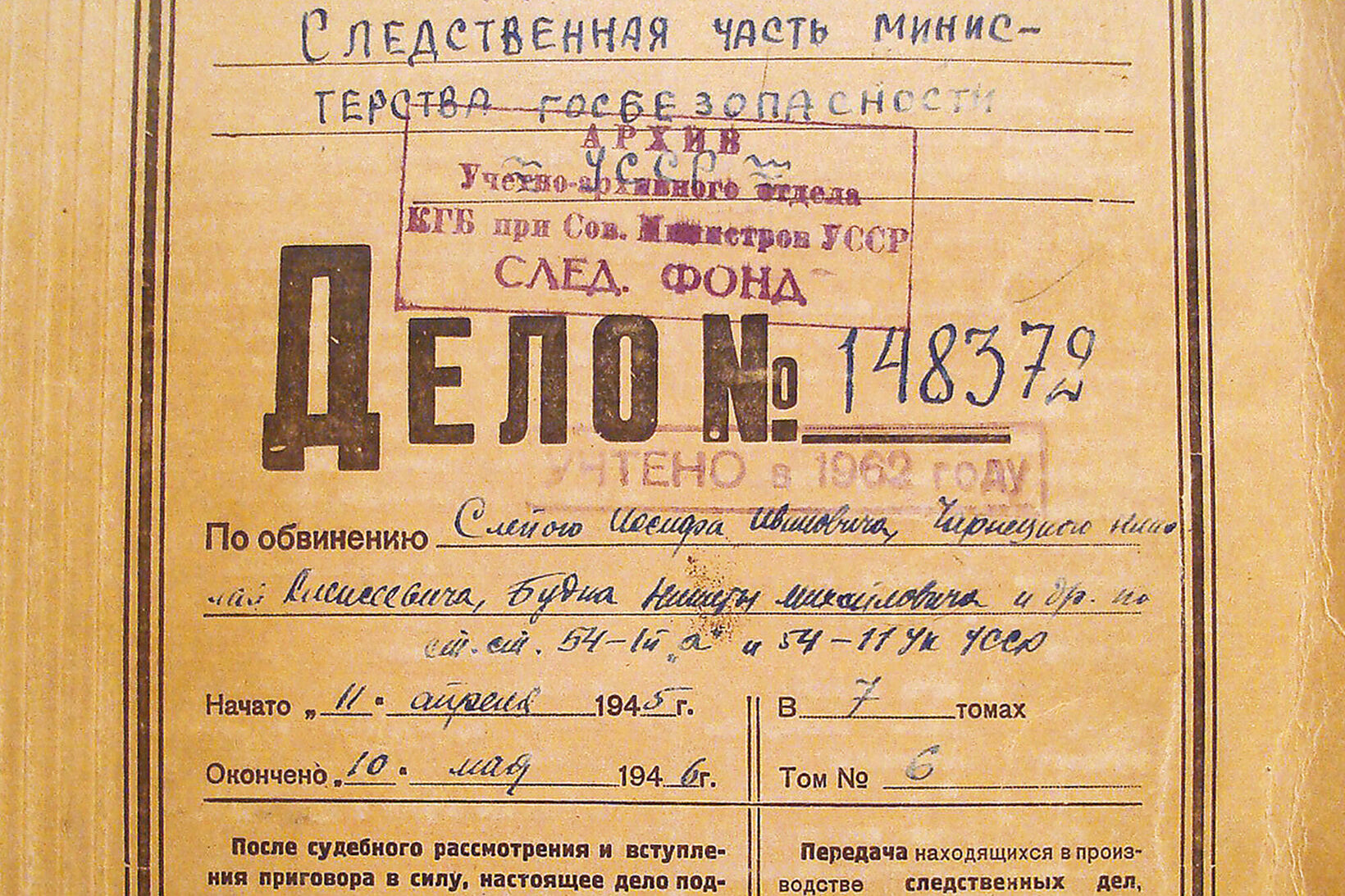
NKVD Case Against Josyf Slipyj / Справа НКВС проти Йосифа Сліпого
|
|
| English | Українська |
|
World War II was one of the most difficult periods in the history of the Ukrainian Greek-Catholic Church. In 1939, Nazi Germany invaded Poland from the west while the Soviet Union invaded from the east and seized western Ukraine. At that time, the UGCC had 2387 parishes and 3.6 million faithful, 2352 diocesan priests, 31 male and 121 female monasteries and monastic houses. |
Період Другої світової війни — один із найскладніших у історії Української Греко-Католицької Церкви. 1939 року Польщу окупували німецькі війська, а Західну Україну — радянські. У той час УГКЦ налічувала 2387 парафій і 3,6 млн. вірних, 2352 єпархіальні священики, 31 чоловічий і 121 жіночий монастирі й чернечі доми. |
|
The Soviet government perceived the Ukrainian Church as a serious obstacle in the implementation of Sovietization of the region. That is why Stalin's regime immediately began to attack the UGCC. The new authorities organized a broad campaign of persecution, intimidation and defamation of the Greek-Catholic bishops and clergy. |
Радянська влада сприймала Українську Церкву як серйозну перешкоду в реалізації політики радянізації регіону. Тому сталінський режим відразу розпочав наступ на УГКЦ. Влада організувала широку кампанію переслідувань, залякування й дискредитації греко-католицького єпископату та духовенства. |
|
On December 22, 1939, with the permission of the Vatican, Metropolitan Andrey secretly ordained Fr. Yosyf Slipy (1892–1984) as bishop with the right of succession to the Galician metropolitan seat. On April 11, 1945, Metropolitan Yosyf Slipy and later other bishops were arrested. |
22 грудня 1939 року з дозволу Ватикану митрополит Андрей таємно висвятив отця Йосифа Сліпого (1892–1984 рр.) на єпископа з правом наступництва на галицькому митрополичому престолі. 11 квітня 1945 року було арештовано митрополита Йосифа Сліпого, а згодом і інших єпископів. |
|
The so-called Lviv Synod of March 8–10, 1946, organized by the government and state security bureau in collaboration with the Sponsoring Group, unanimously adopted the resolution "to revoke the 1596 Council of Brest, to eliminate the Union, to break away from the Vatican and to return to the bosom our Mother Holy Orthodox faith and the Russian Orthodox Church." |
Так званий Львівський собор 8–10 березня 1946 року, організований владою та органами державної безпеки у співпраці з ініціативною групою, одноголосно ухвалив рішення «скасувати Берестейський собор 1596 року, ліквідувати унію, відірватися від Ватикану і повернутися в лоно нашої Матері Святої Православної віри та Російської Православної Церкви». |
|
This act from beginning to end was a true farce, so it was not valid both in terms of church law and state law. However, the Church was considered officially liquidated and its parishes and the faithful were absorbed by the ROC. |
Цей акт від початку і до кінця був справжнім фарсом, тож не мав канонічної сили ні з точки зору церковного, ні з точки зору державного права. Однак Церкву вважали офіційно ліквідованою, а її парафії та вірних поглинула РПЦ. |
| 8. Patriarch Yosyf Slipy 1892–1984 | 8. Патріарх Йосиф Cліпий (1892–1984) |
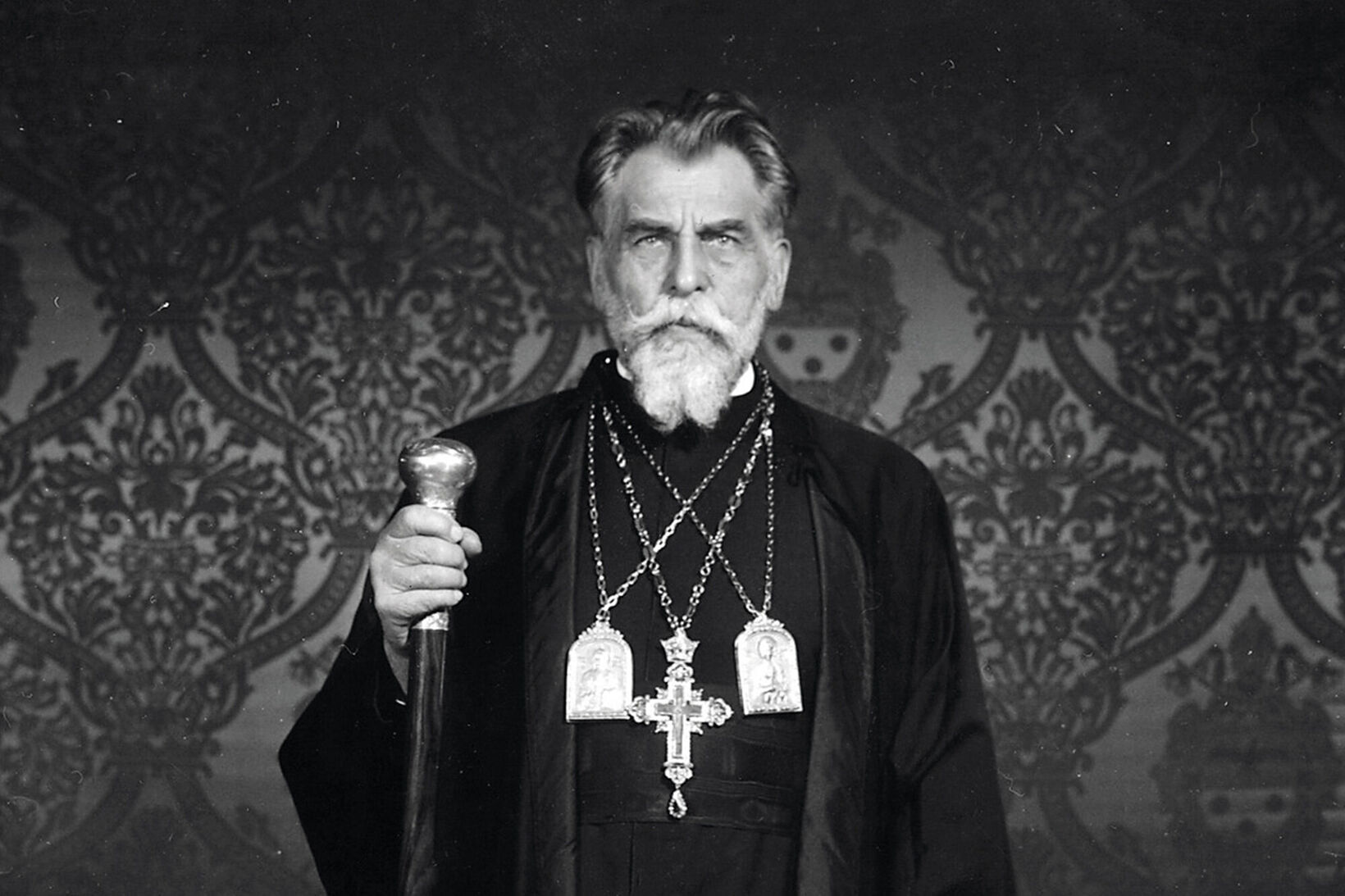
Patriarch Josyf Slipyj / Патріарх Йосиф Сліпий
|
|
| English | Українська |
|
Yosyf Slipy — one of the most colorful figures in the modern history of UGCC. Scientist, theologian, leader of academic institutions, primate of the Ukrainian Church — he was a multifaceted personality. After finishing primary school and Ternopil high school, Yosyf Slipy went to Lviv Theological Seminary in 1911. |
Йосиф Сліпий — одна з найяскравіших постатей у новітній історії УГКЦ. Науковець, богослов, керівник академічних закладів, предстоятель Української Церкви — він був багатогранною особистістю. Закінчивши початкову школу та Тернопільську гімназію, Йосиф Сліпий 1911 року вступив до Львівської духовної семінарії. |
|
Metropolitan Andrey noticed the talented young seminarian, and at the end of his second year sent him to the University of Innsbruck (Austria), where the young Yosyf received a classical education and defended two academic theses in the field of dogmatic theology. |
Митрополит Андрей помітив талановитого молодого семінариста і наприкінці другого курсу направив його до Інсбруцького університету (Австрія), де молодий Йосиф здобув класичну освіту і захистив дві наукові дисертації в галузі догматичного богослов'я. |
|
Metropolitan Slipy spent 18 years in Soviet prisons, camps and in exile. Fellow prisoners mentioned the Metropolitan as a man who was willing to go all the way for his faith and beliefs. In the years 1953–1958, while in exile in a nursing home in Maklakovo, he wrote a multivolume history of the Universal Church in Ukraine. |
Митрополит Сліпий провів 18 років у радянських в'язницях, таборах та засланні. Співв'язні згадували митрополита як людину, яка готова була йти до кінця заради своєї віри й переконань. У 1953–1958 роках, перебуваючи на засланні в будинку престарілих у Маклакові, він написав багатотомну історію Вселенської Церкви в Україні. |
|
In Rome (1963–1984), Metropolitan and later Cardinal and Major Archbishop Slipy concentrated his efforts on protecting the oppressed Church. He used every public forum to emphasize the persecution of churches in the Soviet Union and advocated more radical action in protecting the rights of believers. |
У Римі (1963–1984) митрополит, а згодом кардинал і Верховний архієпископ Сліпий зосередив свої зусилля на захисті гнобленої Церкви. Він використовував кожен публічний форум, щоб наголосити на переслідуваннях церков у Радянському Союзі, і виступав за радикальніші дії щодо захисту прав віруючих. |
|
In 1963 he created the Ukrainian Catholic University, which was to consolidate Ukrainian scientific forces abroad. Patriarch Slipy advocated the preservation of national identity and inter-confessional convergence. In his "Testament", he called attention to the common heritage of the Kyivan Christian tradition as the basis for future understanding. |
У 1963 році він створив Український католицький університет, який мав консолідувати українські наукові сили за кордоном. Патріарх Сліпий виступав за збереження національної ідентичності та міжконфесійне зближення. У своєму «Заповіті» він звернув увагу на спільну спадщину київської християнської традиції як основу для майбутнього порозуміння. |
|
In September 1992, Yosyf Slipy was reburied in accordance with his "Testament" in the crypt of St. George's Cathedral in Lviv next to his predecessor Metropolitan Andrey Sheptytsky. |
У вересні 1992 року Йосифа Сліпого було перепоховано відповідно до його «Заповіту» в крипті собору Святого Юра у Львові поруч із його попередником митрополитом Андреєм Шептицьким. |
| 9. The Church in the underground 1946–1989 | 9. Церква в підпіллі (1946–1989) |
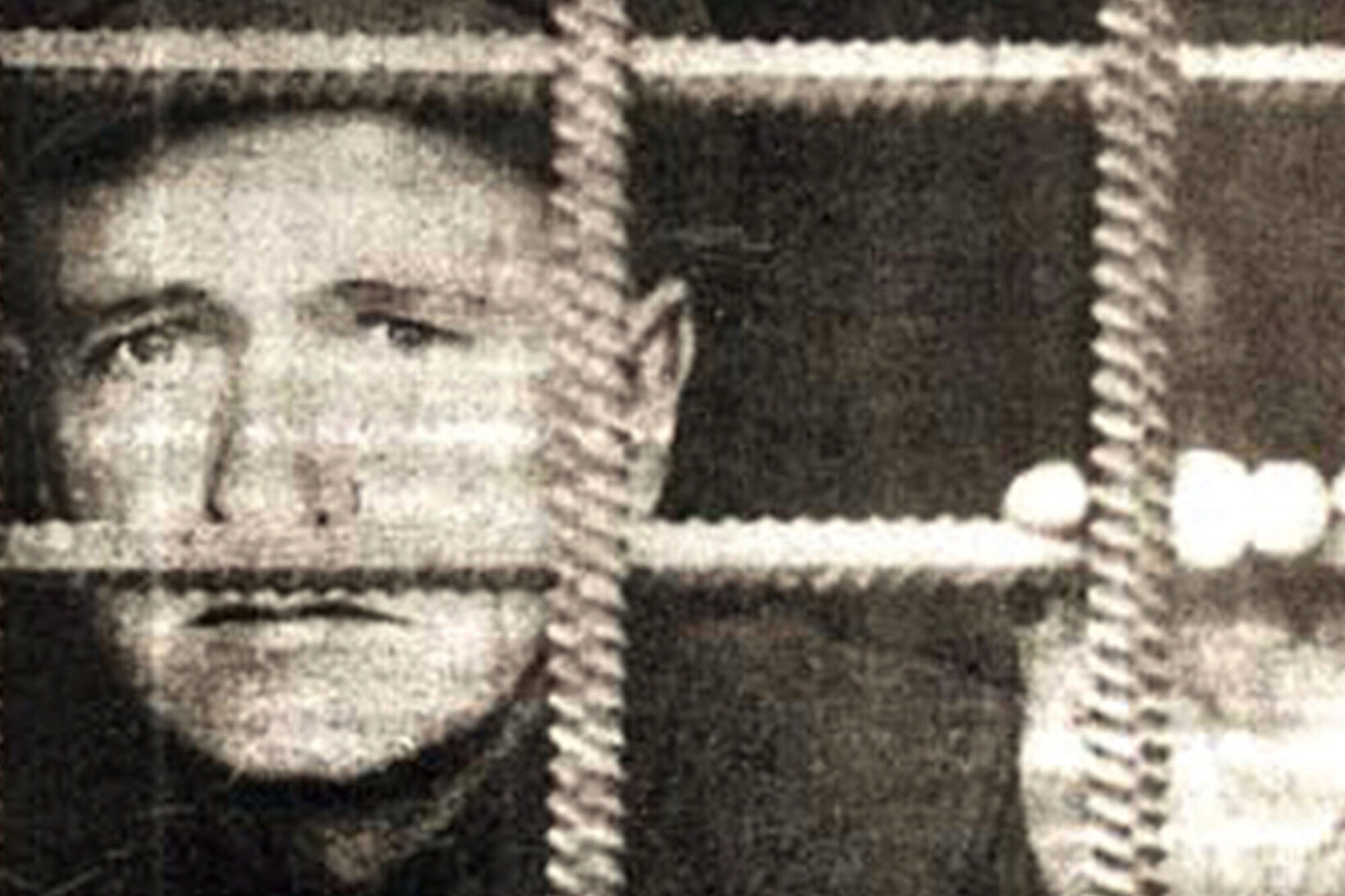
Father Roman Lopatyns'ky. Karaganda, 1955 / Отець Роман Лопатинський. Караганда, 1955
|
|
| English | Українська |
|
Any pastoral work done by Greek-Catholic priests after the Lviv pseudo-council was considered illegal by the authorities, and priests, monks and nuns were repressed. In 1945–1946 alone the KGB arrested and convicted more than 800 Greek-Catholic priests, who received prison terms from 10 to 25 years. |
Будь-яка душпастирська робота греко-католицьких священиків після Львівського псевдособору вважалася владою незаконною, а священики, ченці та черниці зазнавали репресій. Лише у 1945–1946 роках КДБ заарештувало й засудило понад 800 греко-католицьких священиків, які отримали терміни ув'язнення від 10 до 25 років. |
|
Even though the "visible" Church structure was destroyed by the arrests of its bishops, the UGCC succeeded in keeping the continuity of episcopal ministry in the conditions of persecution and deep underground. From 1945 to 1989, fifteen underground bishops were ordained in secrecy. |
Попри те, що «видиму» церковну структуру було зруйновано арештами єпископів, УГКЦ вдалося зберегти тяглість єпископського служіння в умовах переслідувань та глибокого підпілля. З 1945 по 1989 рік таємно було висвячено п'ятнадцять підпільних єпископів. |
|
Despite the unbearable physical and mental conditions in the Soviet camps and harsh conditions in exile, the Greek-Catholic clergy used every opportunity to fulfill their pastoral vocation. In prisons and in exile they held liturgies, prayers, and administered Holy Sacraments. Even priestly ordinations were held in the labor camps. |
Попри нестерпні фізичні та психічні умови в радянських таборах і суворі умови заслання, греко-католицьке духовенство використовувало кожну нагоду для виконання свого пастирського покликання. У в'язницях і на засланні вони служили Літургії, молитви, уділяли Святі Таїнства. Навіть священичі рукоположення відбувалися в таборах примусової праці. |
|
In Galicia, church life continued in hiding, including with the help of those bishops, priests, monks, and faithful who returned from the camps and exile. Secret worship services would take place in private homes, places of pilgrimage, and in front of the closed churches. |
У Галичині церковне життя тривало в підпіллі, зокрема за допомогою тих єпископів, священиків, ченців і вірних, які повернулися з таборів та заслання. Таємні богослужіння відбувалися в приватних будинках, місцях прощ і перед зачиненими храмами. |
|
The Church faithful paid considerable attention to Christian parenting, manufactured and stored liturgical utensils, took care of closed churches, accompanied and guarded their pastors, brought priests to people who needed confession or communion, and hence rightly become indestructible pillars of the underground Church. |
Вірні УГКЦ дбали про християнське виховання дітей, виготовляли та зберігали літургійні речі, опікувалися зачиненими храмами, супроводжували та охороняли своїх душпастирів, шукали священиків для людей, котрі потребували сповіді чи Причастя, а тому по праву стали непорушною опорою Церкви в підпіллі. |
| 10. Revival of the Church 1989 | 10. Відродження Церкви (1989) |
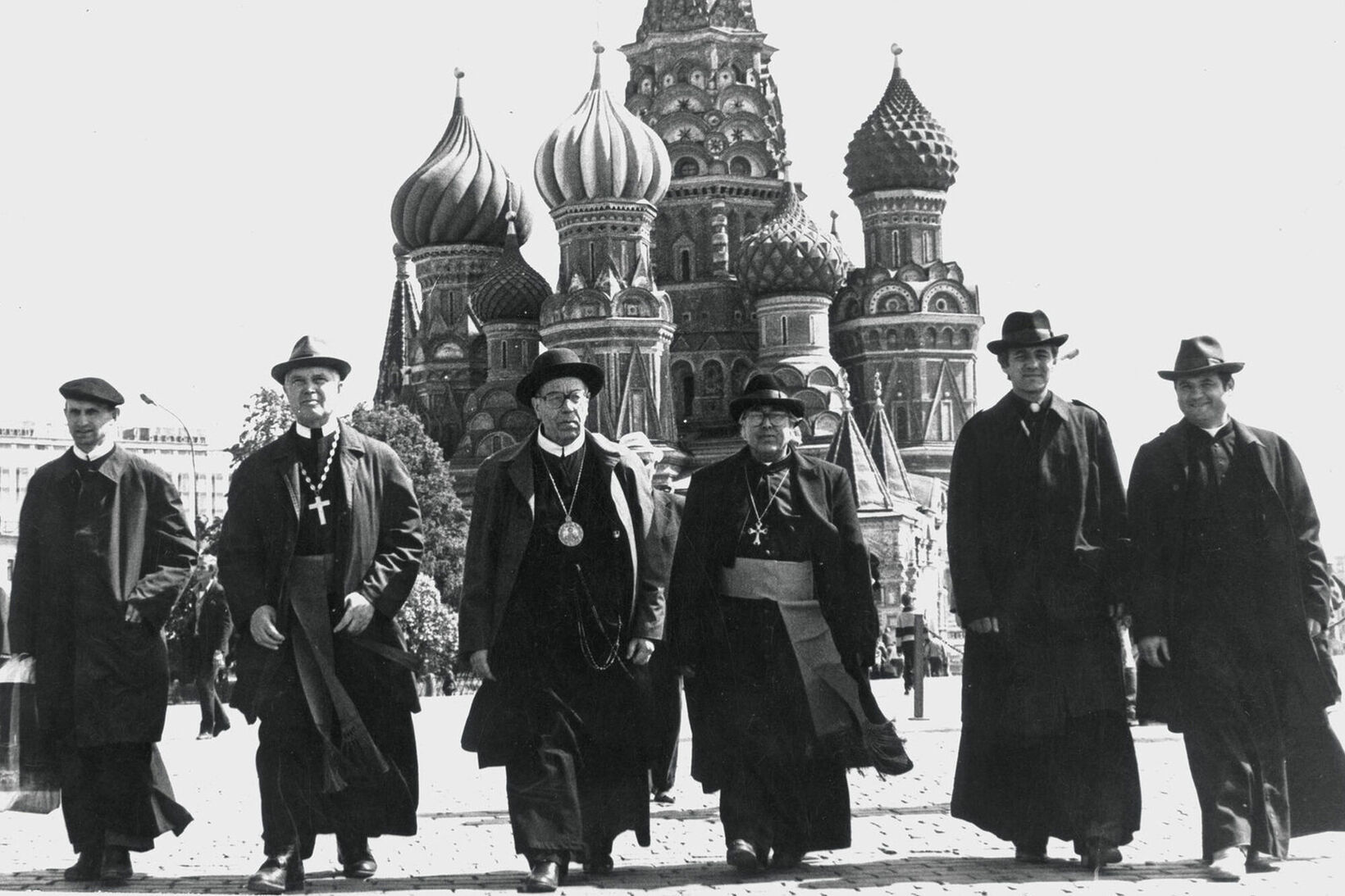
Bishops and Priests of the Catacomb Church in Moscow, 1989 / Єпископи і священники катакомбної Церкви у Москві, 1989
|
|
| English | Українська |
|
During the period of democratization in the Soviet Union in the second half of the 1980s under the leadership of Mikhail Gorbachev, Greek-Catholics decided that they would no longer put up with injustice against the Church. The harbinger of legalization of the UGCC was the August 4, 1987 public statement by a group of 23 priests and faithful under the leadership of Bishop Pavlo Vasylyk that the Church was leaving the underground. |
З огляду на політику демократизації у другій половині 1980-х, яку проводив у СРСР Михайло Горбачов, греко-католики більше не бажали миритися з несправедливістю щодо Церкви. Провісником легалізації УГКЦ стало оприлюднення заяви про вихід з підпілля групи священиків (23 осіб) і вірних під керівництвом владики Павла Василика, датованої 4 серпня 1987 року. |
|
At the end of that year Greek-Catholic activists formed the Committee for the Protection of Rights of the Ukrainian Catholic Church, led by former political prisoner Ivan Hel. The Committee began collecting signatures for a petition demanding the official recognition of the UGCC. About 120,000 signatures were collected over the period of 1988–1989. |
А наприкінці цього ж року активні греко-католики утворили Комітет захисту прав Української Католицької Церкви на чолі з колишнім політв'язнем Іваном Гелем. Комітет розпочав збір підписів під петицією з вимогою офіційного визнання УГКЦ. Протягом 1988–1989 років було зібрано близько 120 000 підписів. |
|
Open-air worship services were held in the towns and villages across western Ukraine. Initially, they drew relatively small numbers of faithful, but they eventually grew into thousand-strong rallies. That same year saw an unprecedented hunger strike of Greek-Catholics in Moscow's Arbat, started by the bishops Pavlo Vasylyk, Sophron Dmyterko and Philemon Kurchaba. |
Богослужіння під відкритим небом відбувалися в містах і селах по всій західній Україні. Спочатку вони збирали порівняно невелику кількість вірних, але згодом переросли в багатотисячні віча. Того ж року відбулася безпрецедентна акція голодування греко-католиків на Арбаті в Москві, яку розпочали єпископи Павло Василик, Софрон Дмитерко і Филимон Курчаба. |
|
Under internal and external pressure the Soviet government was forced to acknowledge the rights of the UGCC, and on November 28, 1989 issued a statement according to which Greek-Catholics were given the right to establish and register communities and enjoy "all the rights established by law for religious organizations in the USSR." |
Під внутрішнім і зовнішнім тиском радянський уряд був змушений визнати права УГКЦ і 28 листопада 1989 року видав заяву, згідно з якою греко-католики отримали право засновувати та реєструвати громади і користуватися «всіма правами, встановленими законом для релігійних організацій в СРСР». |
|
On January 23, 1990, bishops, more than 200 priests and many laymen from across Ukraine gathered for a Church council in the Lviv Transfiguration Church. The council took several decisions, including voiding the decisions of the Lviv pseudo-council of 1946. The return of St. George Archcathedral in Lviv to Greek-Catholics on August 19, 1990 completed the legalization of the Church. |
23 січня 1990 року у Львівському Преображенському храмі зібралися єпископи, понад 200 священиків і багато мирян з усієї України на церковний собор. Собор ухвалив низку рішень, зокрема скасував рішення Львівського псевдособору 1946 року. Повернення архикатедрального собору Святого Юра у Львові греко-католикам 19 серпня 1990 року завершило легалізацію Церкви. |
| 11. Return to Kyiv 2005 | 11. Повернення до Києва (2005) |
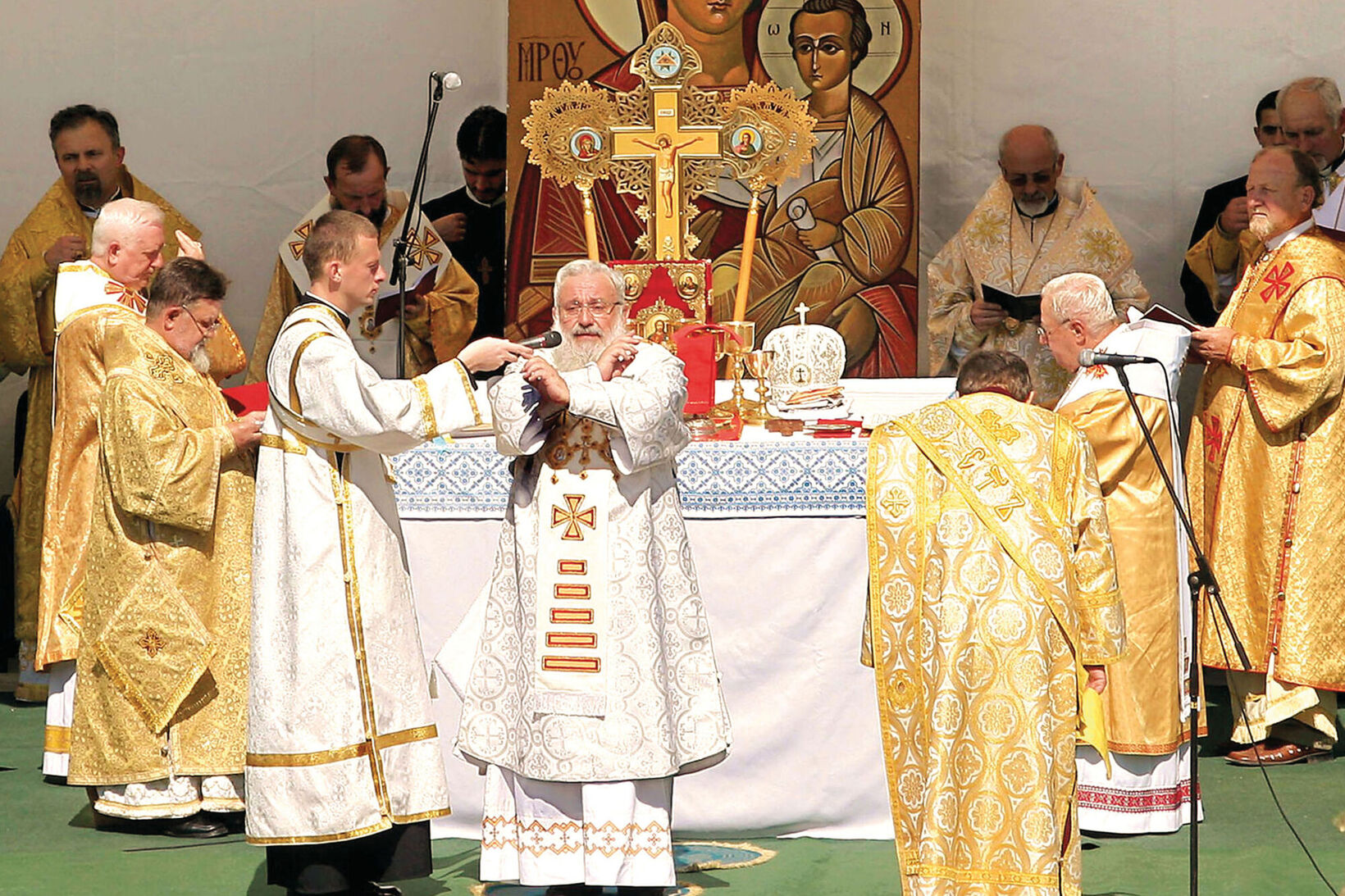
Liturgy on the Occasion of the Return to Kyiv, 2005 / Літургія з нагоди повернення до Києва, 2005
|
|
| English | Українська |
|
Having revived in western Ukraine, Ukrainian Greek Catholic Church implemented a series of reforms concerning the territorial division of eparchies, expanded the jurisdiction of the Major Archbishop and the Synod of Bishops to the entire territory of Ukraine, except Transcarpathia, where the Ukrainian Greek Catholic Church has an autonomous status. |
Відродившись на заході України, Українська Греко-Католицька Церква провела низку реформ щодо територіального поділу єпархій, розширила юрисдикцію Верховного архієпископа та Синоду Єпископів на всю територію України, за винятком Закарпаття, де УГКЦ має автономний статус. |
|
In 2004, His Beatitude Lubomyr (Husar), who was the head of the Ukrainian Greek Catholic Church at that time, with the approval of the Synod of Bishops and with the blessing of the Pope, made the decision to return the See of the Major Archbishop of the Church from Lviv to Kyiv. The official date of return was the 21st of August 2005. |
2004 року тодішній глава УГКЦ Блаженніший Любомир (Гузар) прийняв рішення, затверджене Синодом, яке благословив Папа Римський, про повернення осідку Верховного архієпископа Церкви зі Львова до Києва. Офіційною датою повернення вважається 21 серпня 2005 року. |
|
Since that time, the Ukrainian Greek Catholic Church has activated its ministry throughout the entire territory of Ukraine. In the course of the recent reorganization of the Church at the end of 2011, three new Metropolitan provinces were established in the country. |
Відтоді Українська Греко-Католицька Церква активізувала своє служіння на всій території України. У ході нещодавньої реорганізації Церкви наприкінці 2011 року в країні було створено три нові митрополичі провінції. |
|
Lubomyr Husar described the return to the See of the Head of the Church to Kyiv and the construction of the Patriarchal Cathedral of the Resurrection of Christ on the banks of the Dnieper River as the symbol of "our internal unity." |
Повернення осідку Глави Церкви до Києва та зведення Патріаршого собору Воскресіння Христового на березі Дніпра Любомир Гузар назвав символом «нашого внутрішнього єднання». |
|
"The history of our Church," His Beatitude told the media, "has 1025 years since the Christianization of Kyivan Rus'. The Greek Catholic Church is not a Western, but an all-Ukrainian reality." |
«Історія нашої Церкви, — розповідав Блаженніший Любомир засобам масової інформації, — налічує 1025 років від часів Хрещення Київської Русі. Греко-Католицька Церква — не західна, а всеукраїнська реальність». |
|
The UGCC is a part of the Universal Church with the status of a self-governed Major-Archepiscopal Church. Its head, the Major Archbishop, is in communion with the Holy Apostolic See of Rome. It is the largest among the 22 self-governed Eastern Catholic Churches. |
УГКЦ є частиною Вселенської Церкви зі статусом самоуправної Верховноархієпископської Церкви. Її Глава — Верховний архієпископ — перебуває в єдності із Святим Апостольським престолом у Римі. Вона є найбільшою серед 22 самоуправних Східних Католицьких Церков. |
| 12. The Church today | 12. Церква сьогодні |
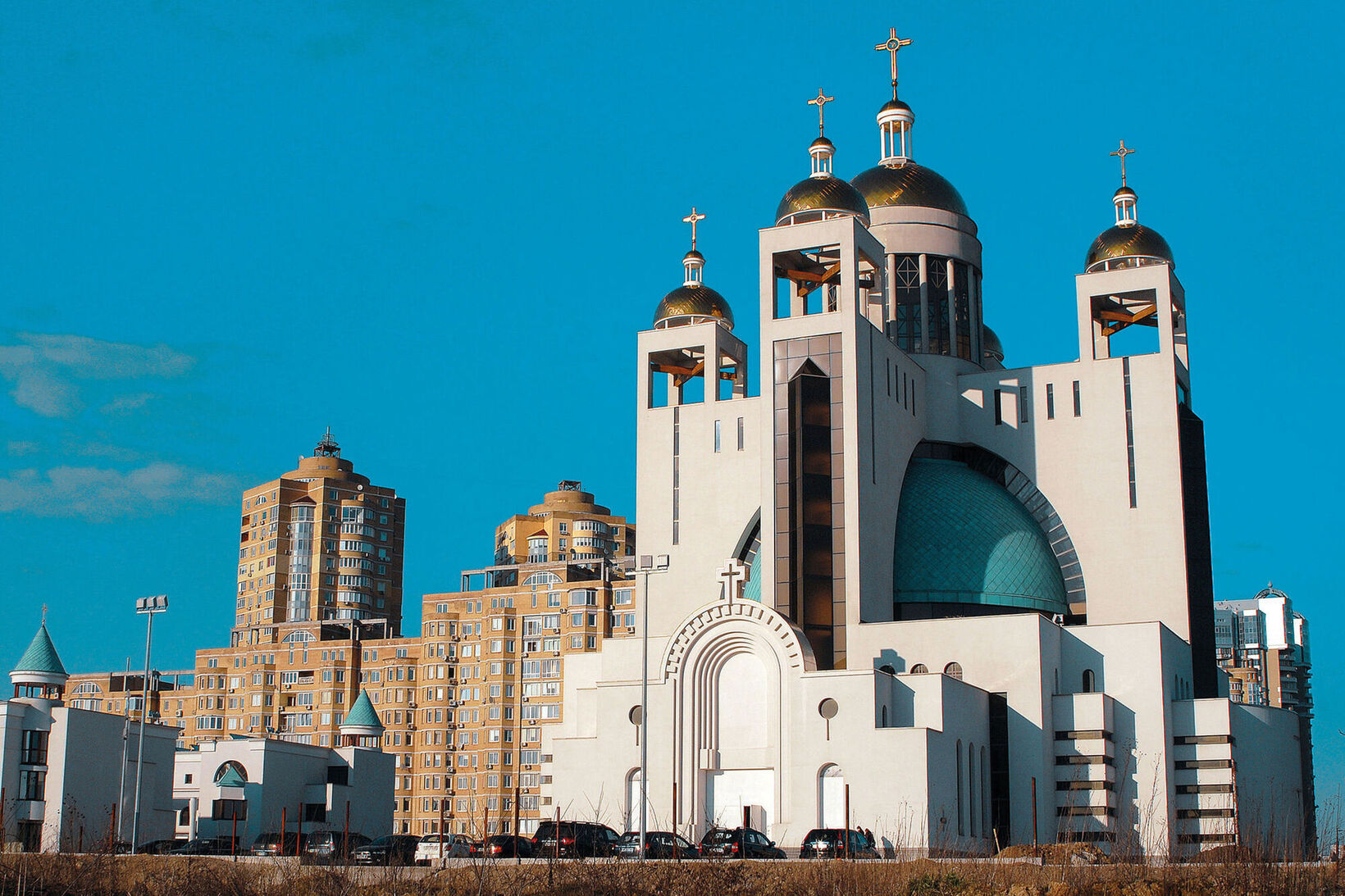
Patriarchal Cathedral of the Resurrection of Christ / Патріарший собор Воскресіння Христового
|
|
| English | Українська |
|
Ukrainian Greek Catholic Church, with more than 6.5 million believers is the largest Eastern Catholic Church in the world. |
Українська Греко-Католицька Церква з понад 6,5 мільйонами вірних є найбільшою Східною Католицькою Церквою у світі. |
|
The head of the UGCC is the Major Archbishop of Kyiv-Halych, His Beatitude Sviatoslav Shevchuk, who succeeded Cardinal Lubomyr Husar in March 2011, after His Beatitude's resignation was accepted by the Pope in February 2011. |
Главою УГКЦ є Верховний архієпископ Києво-Галицький Блаженніший Святослав Шевчук, який став наступником кардинала Любомира Гузара у березні 2011 року після того, як Папа прийняв зречення Блаженнішого в лютому 2011 року. |
|
During the years of 1989–2011, the UGCC held five sessions of the Patriarchal Sobor (Church council): the first was devoted to the question of new evangelization (1996), the second — the role of the laity in the life of the modern Church (1998), the third — problems in Ukrainian society (2002), the fourth — youth (2007), the fifth — monasticism (2011). |
Протягом 1989–2011 років УГКЦ провела п'ять сесій Патріаршого Собору: перша була присвячена питанню нової євангелізації (1996), друга — ролі мирян у житті сучасної Церкви (1998), третя — проблемам українського суспільства (2002), четверта — молоді (2007), п'ята — чернецтву (2011). |
|
In the words of His Beatitude Sviatoslav, "Today our church, by building up its structures, step by step heads toward a patriarchate." "And it's only a matter of time," he told a press conference, "when the Pope, according to his authority, will make this decision public." |
За словами Блаженнішого Святослава, «Сьогодні наша Церква, розбудовуючи свої структури, крок за кроком прямує до патріархату». «І це лише питання часу, — сказав він на прес-конференції, — коли Папа, відповідно до своїх повноважень, оприлюднить це рішення». |
|
The Major Archepiscopal Church in Ukraine is divided into eparchies and exarchates: Kyiv Archeparchy, Lviv Archeparchy, Ivano-Frankivsk Archeparchy, Ternopil-Zboriv Archeparchy, Kolomyia-Chernivtsi Eparchy, Sambir-Droyobych Eparchy, Buchach Eparchy, Stryi Eparchy, Sokal-Zhovkva Eparchy, Donetsk-Kharkiv Exarchate, Odesa-Crimea Exarchate and Lutsk Exarchate. |
Верховноархієпископська Церква в Україні поділяється на єпархії та екзархати: Київська архієпархія, Львівська архієпархія, Івано-Франківська архієпархія, Тернопільсько-Зборівська архієпархія, Коломийсько-Чернівецька єпархія, Самбірсько-Дрогобицька єпархія, Бучацька єпархія, Стрийська єпархія, Сокальсько-Жовківська єпархія, Донецько-Харківський екзархат, Одесько-Кримський екзархат та Луцький екзархат. |
|
The Mukachevo Eparchy of GCC, being formally a church sui juris and not subject to the head of the UGCC, maintains an autonomous status. |
Мукачівська єпархія ГКЦ, будучи формально церквою свого права і не підпорядковуючись главі УГКЦ, зберігає автономний статус. |
Source / Джерело: ugcc.ua
© Ukrainian Greek Catholic Church / Українська Греко-Католицька Церква